

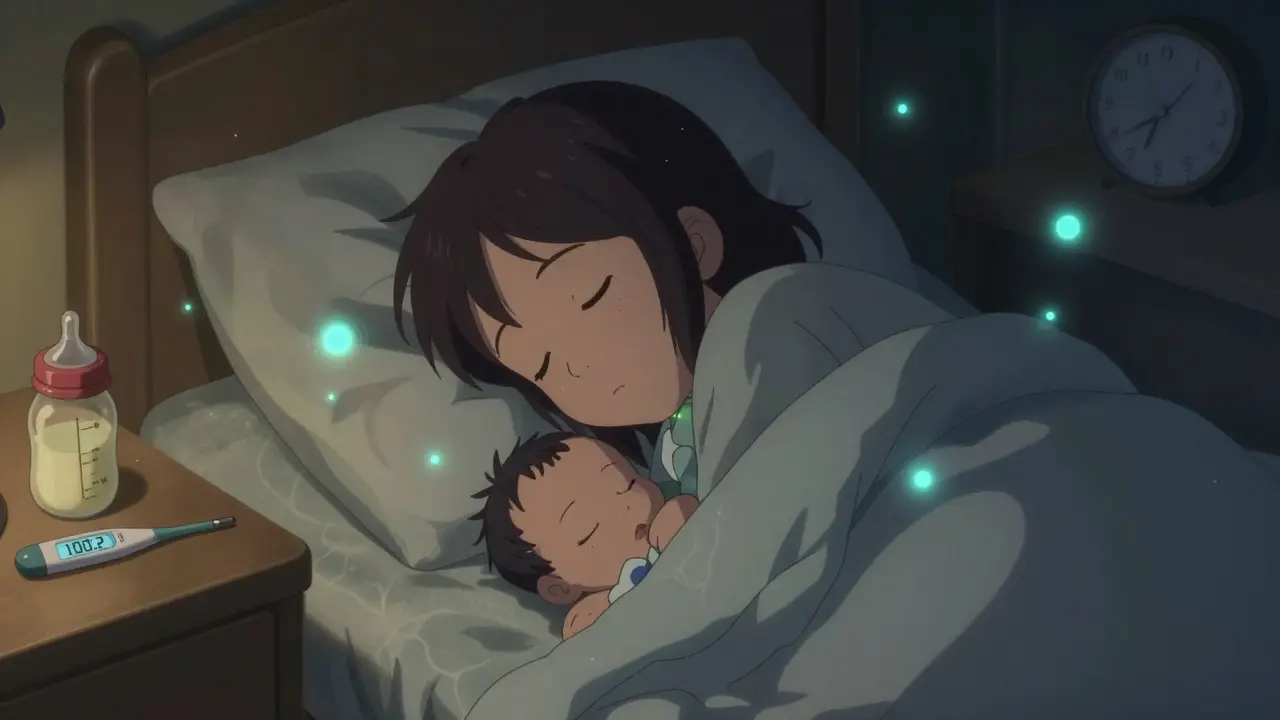
It’s normal to feel anxious when your child gets a fever after a vaccine. You want to help them feel better-fast. But giving fever reducers too soon might actually be doing more harm than good. The truth is, vaccination fever reducers shouldn’t be given before or right after the shot unless there’s a clear medical reason. Here’s what you need to know to keep your child safe and protected.
Why Fever After Vaccines Is Normal
Fever isn’t a side effect you need to panic about-it’s a sign your child’s immune system is doing its job. After vaccines like Prevnar 13 or Pediarix, about 1 in 3 babies develop a low-grade fever within 12 to 24 hours. The MenB vaccine has an even higher chance, with up to 4 in 10 infants running a fever. This isn’t a reaction to the vaccine being dangerous-it’s the body learning how to fight the virus or bacteria in the vaccine. Most fevers last only 1 to 2 days and go away on their own.Why Giving Fever Reducers Too Early Can Backfire
In the early 2000s, many parents and even some doctors routinely gave acetaminophen (Tylenol) right after vaccines to prevent fever. But research changed that. A major 2009 study in The Lancet showed that giving fever reducers before or immediately after vaccination lowered the immune response. Follow-up studies confirmed it: children who got acetaminophen or ibuprofen within the first few hours after shots produced fewer antibodies against the diseases the vaccines were meant to protect them from. This isn’t about making your child uncomfortable-it’s about making sure the vaccine works. Even if the antibody levels stay above the protective threshold, reducing them means less long-term defense. The Children’s Hospital of Philadelphia and the CDC both say: Don’t give fever reducers before or right after vaccination unless your child is already running a high fever.The 4-Hour Rule: When It’s Safe to Give Medicine
The good news? You don’t have to wait days. Research shows that if you wait at least 4 hours after the vaccine, giving fever reducers doesn’t interfere with the immune response. A 2016 Polish study compared two groups: one that got medicine right after the shot, and another that waited until 6-8 hours later. The group that waited had normal antibody levels. The group that got medicine early didn’t. So here’s the simple rule: Wait 4 hours after the vaccine before giving acetaminophen or ibuprofen. If your child is calm, feeding well, and not running a high temperature, you can wait even longer. Let their body do the work. If they’re fussy, hot to the touch, or crying more than usual, check their temperature.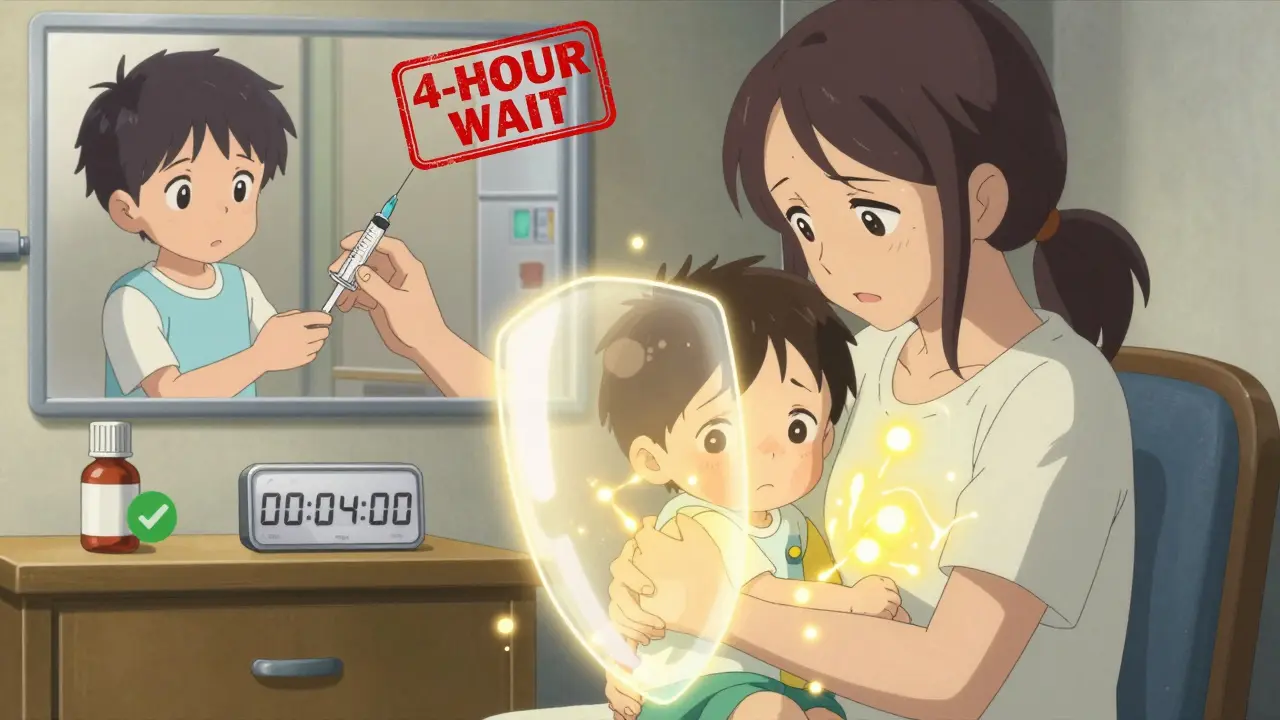
When to Actually Give Fever Reducers
Not every fever needs medicine. Here’s what experts recommend:- Below 100°F (37.8°C): No medicine needed. Keep them cool, hydrated, and comfortable.
- 100-102°F (37.8-39°C): Still usually no need for medication. Monitor closely. Offer fluids, dress lightly, and check on them every few hours.
- Over 102°F (39°C): This is when fever reducers make sense. Use acetaminophen or ibuprofen based on your child’s weight and age.
Seattle Children’s Hospital and the NHS both warn that treating low-grade fevers might actually slow down the immune response. Your child’s fever is helping them build immunity. Don’t fight it unless it’s high.
Dosing Guide: How Much and How Often
Never guess the dose. Always use weight-based charts. Here’s a quick reference for common infant weights:- 6-11 months (18-23 lbs / 8-10 kg): 1.25 mL acetaminophen (160 mg/mL) every 4-6 hours, or 2.5 mL ibuprofen (100 mg/mL) every 6-8 hours.
- Maximum doses: No more than 4 doses of acetaminophen in 24 hours. No more than 4 doses of ibuprofen in 24 hours.
Important warnings:
- Never give aspirin to anyone under 20. It can cause Reye’s syndrome-a rare but deadly illness.
- Don’t give acetaminophen to babies under 12 weeks old without talking to a doctor first.
- Ibuprofen isn’t approved for infants under 6 months in most guidelines. Check with your pediatrician.
The One Big Exception: MenB Vaccine
The UK’s National Health Service (NHS) is the only major health body that recommends giving liquid paracetamol (acetaminophen) after the MenB vaccine at 8 and 16 weeks. Why? Because this vaccine causes fever in up to 40% of babies-and sometimes the fever spikes dangerously high. The NHS weighed the risk of high fever against the small risk of reduced immunity and decided the trade-off was worth it. This is the only vaccine where prophylactic fever reducers are officially recommended. Even then, it’s given after the shot-not before. And only for these two doses in the first year.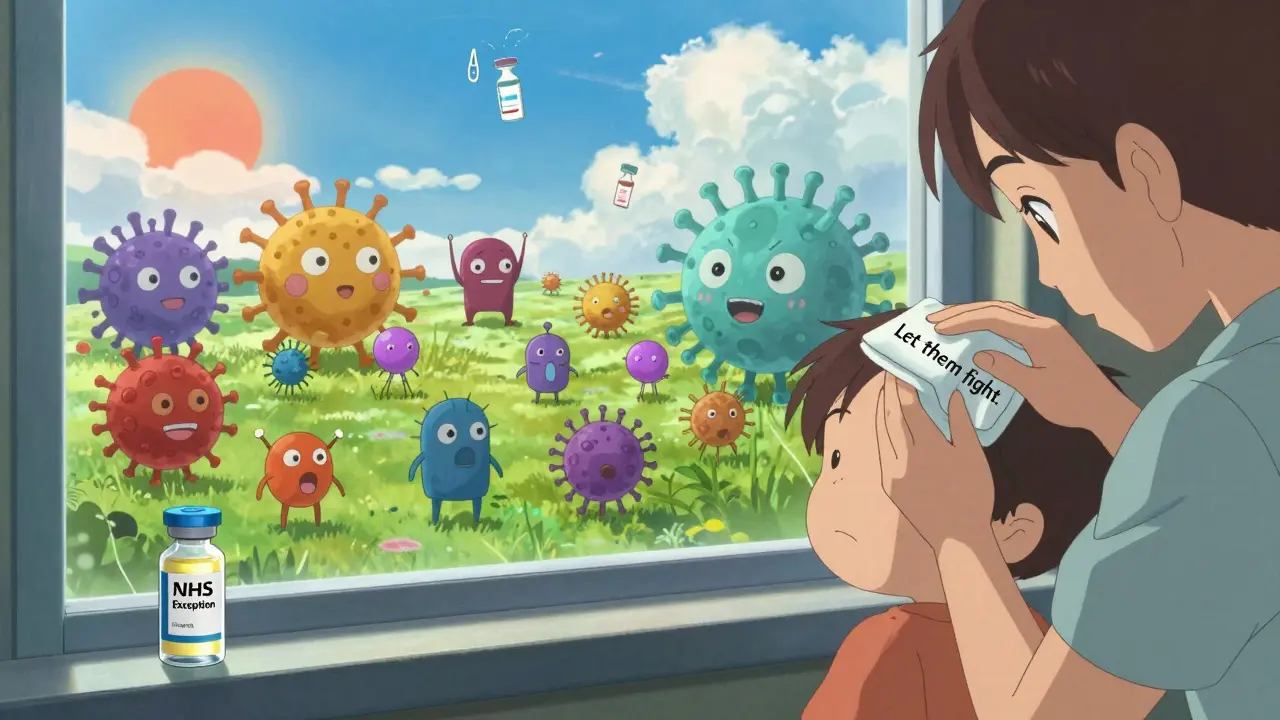
What to Do Instead of Medication
You don’t need pills to help your child feel better. Try these simple, proven methods:- Offer extra breast milk, formula, or water. Dehydration makes fever feel worse.
- Dress them in one light layer. Over-bundling traps heat and raises body temperature.
- Use a lukewarm sponge bath only if they’re very hot and uncomfortable. Never use cold water or alcohol.
- Let them rest. Cuddling and quiet time help recovery more than you think.
When to Call the Doctor
Most post-vaccine fevers are harmless. But call your pediatrician if:- Your baby is under 12 weeks old and has a fever of 100.4°F (38°C) or higher.
- The fever lasts more than 48 hours.
- Your child won’t drink, is lethargic, has a rash, or is having trouble breathing.
- You’re unsure whether the fever is from the vaccine or something else.
Remember: Mild illness doesn’t stop vaccines from working. If your child already had a low fever before the shot, they can still get vaccinated. The vaccine isn’t less effective because of it.
Final Takeaway: Let the Vaccine Work
Your instinct to comfort your child is natural. But sometimes, the best thing you can do is wait. Fever reducers are tools-not emergencies. By waiting 4 hours after the vaccine and only using them for high fevers, you’re helping your child build stronger, longer-lasting protection.It’s not about being tough. It’s about being smart. The immune system doesn’t need help-it needs space to do its job. And your job as a parent is to give it that space-without rushing to medicine at the first sign of warmth.
Can I give my baby fever medicine before their vaccines?
No. Giving fever reducers like acetaminophen or ibuprofen before vaccination can reduce the child’s immune response to the vaccine. Major health organizations including the CDC and Children’s Hospital of Philadelphia recommend against it. Wait until after the shot, and only give medicine if the fever is high or your child is clearly uncomfortable.
How long after a vaccine should I wait before giving fever medicine?
Wait at least 4 hours after the vaccine before giving acetaminophen or ibuprofen. Studies show that giving medicine after this window doesn’t interfere with antibody production. If your child is fine and not running a high fever, you can wait even longer-sometimes up to 24 hours-before needing to give anything.
Is it safe to give ibuprofen after vaccines?
Yes, but only if your child is over 6 months old and the fever is above 102°F (39°C). Ibuprofen is effective and safe for older infants when used correctly. Never give it to babies under 6 months without consulting your doctor. Always use the right dose based on weight, and never exceed 4 doses in 24 hours.
Does a fever after vaccines mean the vaccine didn’t work?
No. A fever means the immune system is reacting-and that’s a good sign. Even if the fever reduces antibody levels slightly, the body still builds enough protection to prevent serious disease. The goal isn’t to avoid all fever-it’s to avoid unnecessary medication that could weaken the response.
Why does the NHS recommend paracetamol after MenB but not other vaccines?
The MenB vaccine causes fever in up to 40% of babies, and sometimes the fever spikes very high, increasing the risk of febrile seizures. The NHS decided the benefit of preventing dangerous high fevers outweighs the small risk of slightly reduced immunity. This is the only vaccine with this official recommendation. For all other vaccines, prophylactic fever reducers are not advised.
Can my child get vaccinated if they already have a fever?
Yes. A mild fever (under 101°F) or a cold doesn’t stop vaccines from working. The CDC says children can still be vaccinated with mild illnesses. Only delay vaccination if your child has a moderate to high fever (over 101.5°F) or is very unwell. In those cases, wait until they’re feeling better.
Nancy Kou
December 20, 2025 AT 04:54My son got his vaccines last week and spiked a fever at 3 a.m. I didn’t give him anything until six hours later. He slept through it. Turned out fine. Letting the body do its thing is wild when you stop fighting it.
Best parenting decision I’ve made all year.
Ryan van Leent
December 20, 2025 AT 06:54They say don't give tylenol right away but my kid throws a fit when he's hot and i'm not gonna sit there watching him cry for 4 hours just to prove some study right
you're not a lab rat your kid is a person
mary lizardo
December 20, 2025 AT 19:08It is regrettable that the prevailing cultural paradigm has shifted toward the infantilization of parental responsibility, wherein discomfort is equated with pathology. The cited Lancet study, while methodologically sound, is often misapplied by laypersons lacking statistical literacy. The immune modulation observed is not equivalent to immunological failure, and the clinical significance remains debatable.
Moreover, the 4-hour window is not universally validated across populations. The Polish cohort was homogeneous; extrapolation to diverse pediatric populations lacks epidemiological rigor.
Hussien SLeiman
December 22, 2025 AT 14:15Of course you’re going to listen to the CDC over your own instincts - because nothing says ‘responsible parenting’ like outsourcing your judgment to an agency that once said smoking was safe for kids.
Let me guess - you also believe in fluoride in the water and that vaccines don’t cause autism. You’re not brave, you’re just gullible.
My kid got a 104 after his shots. I gave him ibuprofen at 90 minutes. He didn’t get sick. The vaccine worked fine. You’re just scared of being wrong.
And don’t even get me started on the MenB exception. That’s the one where they admit the system is broken. Why not just admit they’re all lying about the rest?
Sajith Shams
December 23, 2025 AT 17:46Actually, the 2009 Lancet study had a small sample size - only 127 infants. The 2016 Polish study? They used rectal temps, which are more accurate than axillary. Most parents use forehead strips - those are garbage. So your 4-hour rule is based on flawed data.
Also, antibody titers don’t equal real-world immunity. My cousin’s kid got all shots, no meds, still got pertussis at age 4. So much for ‘stronger immunity.’
Bottom line: if your kid is miserable, give the medicine. Science can’t tell you how to parent. Only experience can.
Chris Davidson
December 24, 2025 AT 14:49Wait 4 hours then give fever reducers? That’s the official recommendation? What’s next? Wait 12 hours before giving water to a dehydrated child?
This is the kind of logic that makes people stop trusting doctors.
Fevers are scary. Kids cry. Parents panic. You don’t fix that with a chart. You fix it with compassion.
And if the vaccine doesn’t work because you waited too long? Who’s liable?
Glen Arreglo
December 25, 2025 AT 11:30I’m an immigrant dad from rural India. Back home, we never gave medicine for fever after shots. We used wet cloths, cool rooms, and patience. My daughter got every vaccine, no meds, never had a seizure. She’s 12 now, healthy as a horse.
Western medicine overthinks everything. Sometimes the body knows better than the algorithm.
Let it ride. Let it breathe. Let it heal.
benchidelle rivera
December 26, 2025 AT 06:53Let me be clear: if you are giving fever reducers within 4 hours of vaccination, you are not being a good parent - you are being a passive participant in the erosion of public health.
The data is not ambiguous. The CDC, WHO, and AAP are aligned. This is not opinion. This is evidence-based medicine.
Parents who ignore this are not ‘trusting their instincts’ - they are undermining herd immunity. One less antibody response could mean one more child in the ICU next flu season.
Do better.
Andrew Kelly
December 26, 2025 AT 20:38Wait 4 hours? That’s what they want you to believe. But what if the real reason they don’t want you giving Tylenol is because Big Pharma makes more money off the next round of vaccines if the immune system is weakened? Think about it.
They’ve been lying about everything - vaccines, masks, 5G, the moon landing. Why should this be different?
I gave my kid ibuprofen at 2 hours. He’s fine. The world is still spinning. Maybe the ‘studies’ are just PR.
Ashley Bliss
December 28, 2025 AT 00:24I cried for three hours after reading this. Not because my baby had a fever - but because I realized I’ve been fighting his body like it’s the enemy.
I used to panic every time his temperature hit 99.8. I’d reach for the medicine like it was a lifeline.
But what if his fever wasn’t trying to kill him? What if it was trying to save him?
I waited. I held him. I sang him lullabies. He slept. He woke up smiling. No meds.
I didn’t just save him from a pill. I saved him from my fear.
Dev Sawner
December 28, 2025 AT 11:31The referenced Polish study (2016) utilized a non-randomized, non-blinded design with a sample size of 48 infants. The primary endpoint - antibody titers - was measured at 28 days post-vaccination, which is insufficient to assess long-term immunological memory. Furthermore, no adjustment was made for confounding variables such as maternal antibody transfer or nutritional status.
Therefore, the conclusion that a 4-hour delay confers a clinically meaningful advantage is statistically unsupported. The recommendation is premature and potentially harmful in resource-limited settings where fever management is critical.
Moses Odumbe
December 29, 2025 AT 08:46bro just give the tylenol 😭 it’s not a big deal
i gave mine at 1 hour and he still got full immunity
also i gave him a banana and he smiled
parenting is not a lab experiment 🙃
Emily P
December 30, 2025 AT 23:36Can someone explain why the MenB exception exists? If all vaccines are affected by early fever reducers, why is this one singled out? Is it because the fever risk is so high that even a slight drop in antibodies is acceptable? Or is there something unique about the MenB antigen that makes it less sensitive to suppression?
I’m genuinely curious. I’ve read the NHS guidelines, but the rationale feels under-explained.
Vicki Belcher
January 1, 2026 AT 00:43I used to be the mom who panicked at 99.5. Now I’m the mom who sings to my kid while he burns up. He’s 14 months. No meds until 102.5. He’s healthy. Happy. Strong.
You’re not failing if you wait. You’re succeeding.
❤️
Danielle Stewart
January 1, 2026 AT 11:47As a pediatric nurse of 18 years, I’ve seen parents agonize over every tenth of a degree. The truth? Most fevers after vaccines are harmless. The real danger is the guilt you feel for not medicating fast enough.
Let go of the fear. Trust the science. Trust your child’s body.
You’re doing better than you think.