

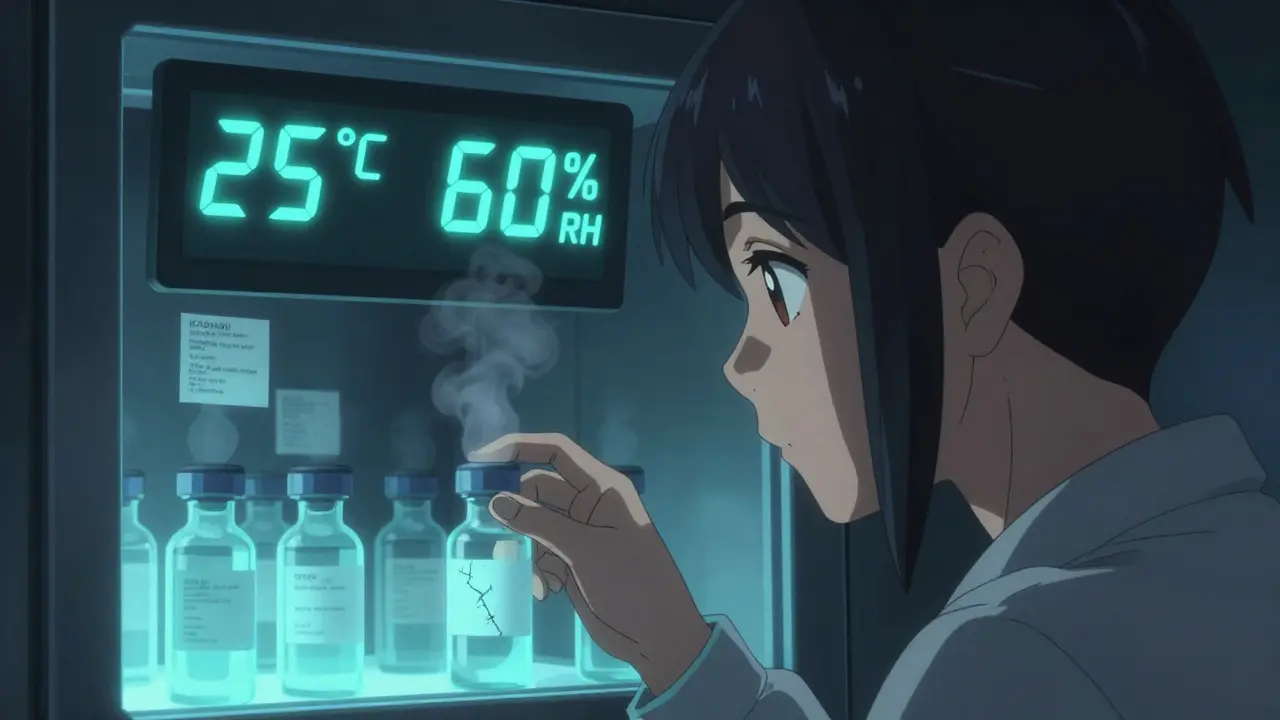
Why Stability Testing Matters
Every pill, injection, or inhaler you take must stay safe and effective from the moment it’s made until the last dose is used. That’s not luck-it’s the result of strict stability testing. This process isn’t optional. It’s required by law in every major market: the U.S., Europe, Canada, Japan, and beyond. If a drug degrades too much over time, it could lose potency, form harmful byproducts, or fail to work when someone needs it most. The stakes are high. In 2022, the FDA issued 27 warning letters just for stability testing failures. One recall involved 150,000 vials of a generic drug because it didn’t hold up under heat. That’s not a minor error-it’s a patient safety issue.
What the Rules Say: ICH Q1A(R2) Standards
The global gold standard for stability testing is ICH Q1A(R2), set by the International Council for Harmonisation. This isn’t some suggestion-it’s the binding rule used by the FDA, EMA, and other regulators. The guidelines define exact temperature and humidity conditions for three types of tests: long-term, accelerated, and intermediate. These aren’t guesses. They’re based on decades of research into how drugs break down under real-world stress.
For long-term testing, you have two options:
- 25°C ± 2°C with 60% RH ± 5% RH
- 30°C ± 2°C with 65% RH ± 5% RH
Which one you pick depends on where the product will be sold. If it’s going to a hot, humid country like India or Brazil, you’ll likely choose the 30°C condition. If it’s for Europe or Australia, 25°C is more common. The key is you must test for at least 12 months before you can submit your application to regulators like the FDA. The EMA allows 6 months at submission, but if you want global approval, you need the full 12.
Accelerated Testing: The 40°C Stress Test
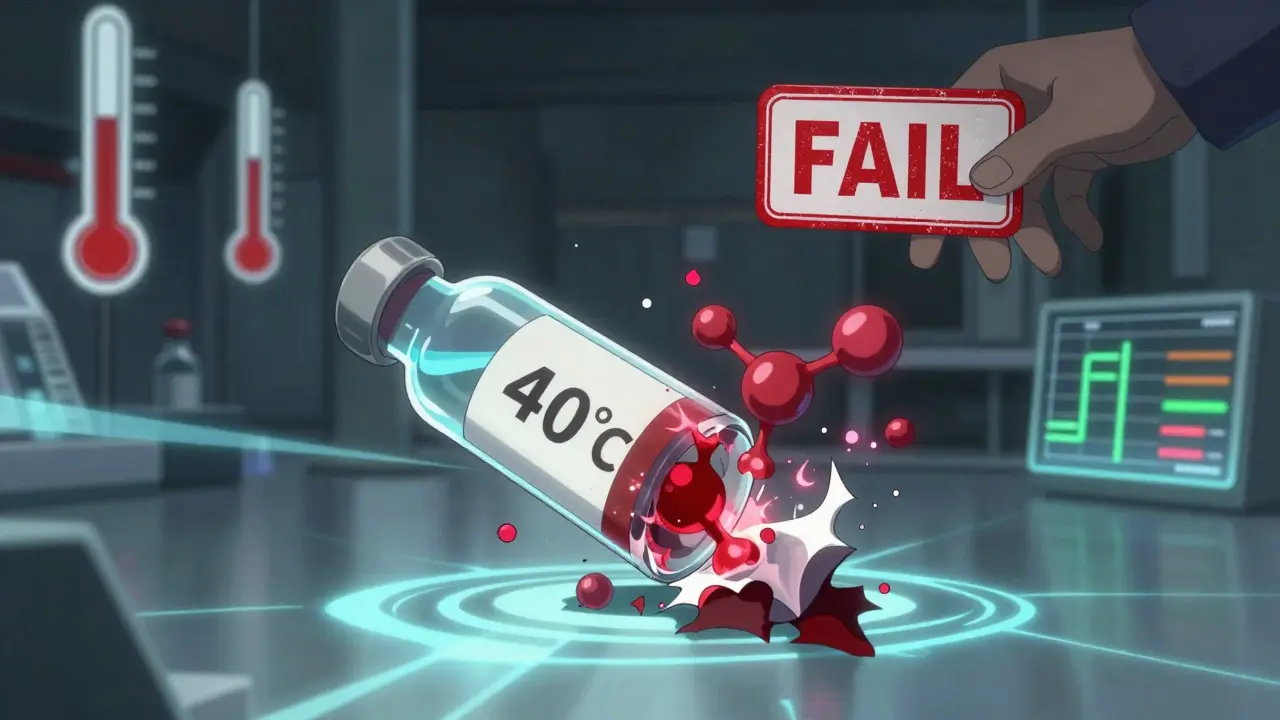
Accelerated testing is your early warning system. It’s done at 40°C ± 2°C and 75% RH ± 5% RH for six months. This isn’t meant to mimic real storage-it’s meant to push the product to its limits. Think of it like a crash test for your drug. If it holds up here, you can predict how it’ll behave over years under normal conditions.
Here’s the math behind it: 6 months at 40°C roughly equals 24 months at 25°C for 85% of small-molecule drugs. That’s why this test is so powerful. But it’s not perfect. For hygroscopic drugs-those that absorb moisture from the air-this correlation breaks down. That’s why you can’t rely on accelerated data alone. It’s a tool, not a replacement for real-time testing.
Refrigerated Products Have Different Rules
Not all drugs are stored at room temperature. Insulin, vaccines, and many biologics need to be kept cold. For these, the rules change. Long-term testing happens at 5°C ± 3°C for 12 months. But here’s the twist: accelerated testing for refrigerated products isn’t done at 40°C. Instead, it’s done at 25°C ± 2°C with 60% RH ± 5% RH for six months. Why? Because freezing and thawing are the real enemies here, not heat. A vial of insulin that’s been left on a hot truck won’t just degrade-it could clump and become dangerous.
What Counts as a ‘Significant Change’?
This is where things get messy. ICH Q1A(R2) says a product has failed if it shows a ‘significant change’ in any of these areas:
- Assay (active ingredient) drops by more than 5%
- Any impurity exceeds its acceptance limit
- Physical properties change-color, texture, dissolution rate
But here’s the problem: there’s no exact formula. One regulator might say a 4.9% drop is fine. Another might reject it. A Pfizer analyst once shared on Reddit how their product failed because the assay was 4.8% below target-even though statistically, it wasn’t significant. The regulator didn’t care about the math. They cared about the number. That’s why stability teams spend months preparing for audits, not just running tests.
Real-World Challenges: Chambers, Humidity, and Human Error
Setting up a stability chamber sounds simple: plug it in, set the temperature, and wait. But it’s not. Temperature must stay within ±0.5°C. Humidity within ±2%. Most labs fail this on day one. A 2023 survey of 142 professionals found that 78% had at least one temperature excursion during a 12-month study. One 3°C spike over 48 hours can invalidate the whole test. That’s not just wasted time-it’s lost money. A single failed study can cost $50,000 or more.
Humidity is even trickier. In dry climates like Arizona or Australia, keeping 65% RH in a chamber requires adding steam. In humid places, it’s the opposite-you need to pull moisture out. Many labs use dual-loop systems now, cutting RH variation from ±8% to ±3%. That’s the difference between a passing and failing test.
What’s Changing? The Future of Stability Testing
The ICH Q1A(R2) guidelines haven’t changed since 2003. That’s 22 years. Meanwhile, the industry has moved on. mRNA vaccines, antibody-drug conjugates, and lipid nanoparticles don’t behave like traditional pills. They’re sensitive to freeze-thaw cycles, light, and even tiny vibrations. Standard tests don’t catch these failures.
That’s why the FDA is testing something called Real-Time Stability Assessment using Process Analytical Technology (PAT). Instead of waiting a year to check a batch, you monitor it continuously during manufacturing. Early results show this could cut testing time by 30-50%. Some companies are already using predictive models-running tests at 50°C, 60°C, even 80°C-to forecast stability in months instead of years. But regulators are skeptical. The EMA rejected eight model-based submissions in 2022 and 2023 because they didn’t trust the math.
By 2030, McKinsey predicts 60% of stability data will come from models, not physical testing. But until regulators fully accept this, companies still need to run the 12-month tests. The rules haven’t caught up to the science-and they won’t until someone proves it’s safe.
What Happens If You Don’t Get It Right?
Failure isn’t just a delay. It’s a business killer. A single stability failure can trigger a recall, a warning letter, or even a ban on selling your product. In 2021, Amgen got a warning letter because their monoclonal antibody degraded under heat. Roche had the same issue. Both had to halt shipments. The cost? Millions in lost sales and reputational damage.
Smaller companies are especially vulnerable. A 2023 survey found that 67% of projects were delayed by stability testing issues. For a startup with limited cash, that delay can mean running out of funds before the product even reaches market. That’s why many now outsource to specialized CROs like WuXi AppTec or Charles River Laboratories. It’s expensive-$185,000 to $275,000 per product-but cheaper than a recall.
Getting Started: What You Need
If you’re building a stability program, here’s what you need:
- Qualified chambers: Install and test them using ASTM E1993-19 standards. This takes 3 weeks per unit.
- Environmental mapping: Place sensors on every shelf. You’ll find hot spots and cold spots you didn’t know existed.
- Stability protocol: Document every detail-where samples go, when they’re tested, what’s measured. This document must be approved by QA before you start.
- Trained staff: Stability analysts need 6-9 months of training to understand statistics, chamber operation, and regulatory expectations.
- Documentation: Keep raw data for at least 10 years. A typical dossier runs 450-600 pages.
There’s no shortcut. But if you do it right, you don’t just meet the rules-you build trust. Patients, regulators, and investors all care about one thing: Is this drug safe? Stability testing is how you prove it.