

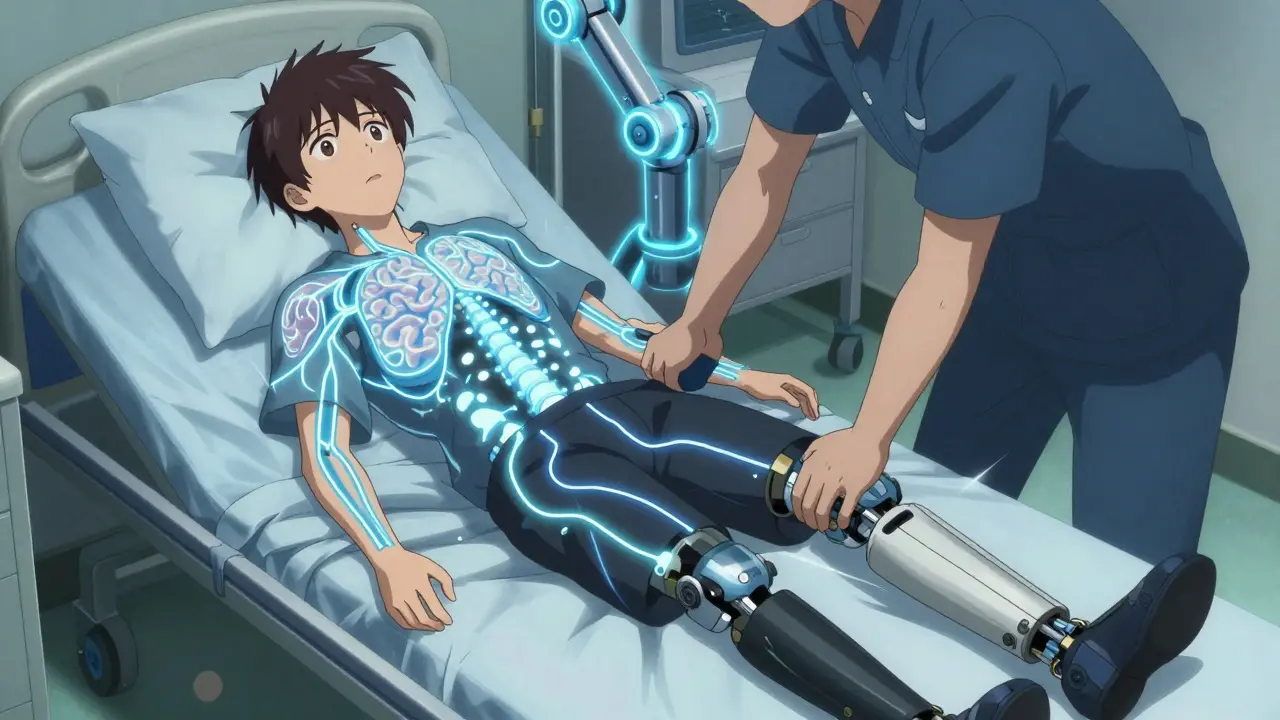
When a spinal cord injury happens, it doesn’t just change how you move-it rewires your whole life. The damage cuts off signals between your brain and parts of your body below the injury. That means you might lose the ability to walk, feel touch, control your bladder, or even breathe without help. The severity depends on where the injury is and how badly the cord is damaged. A break at C4? You could lose movement in your arms and legs. A lower injury at T12? You might keep your arms but lose leg function. The key fact: spinal cord injury isn’t just about paralysis. It’s about losing control over everything from sweating to sexual function. And recovery isn’t a straight line-it’s a long, messy, often frustrating journey.
What Gets Lost After a Spinal Cord Injury?
The body doesn’t just stop working below the injury-it starts acting on its own in ways that can be dangerous. Muscles go limp at first, then often tighten up into painful spasms. Sensation fades, so you might not feel a pressure sore forming on your tailbone until it’s deep and infected. Your bladder and bowels stop responding to signals, meaning you need strict routines to avoid leaks or blockages. Autonomic dysreflexia-a sudden, life-threatening spike in blood pressure-can hit people with injuries above T6 if something like a full bladder goes unnoticed.
People with injuries at C1-C4 often need ventilators because their diaphragm doesn’t work. Those with C5-C6 injuries might keep some elbow and wrist movement but lose fine hand control. At T12 or lower, you might keep full arm function but lose leg movement. The real challenge? You can’t predict how much will come back. Only 1-3% of people with complete injuries ever walk again. But 59% of those with incomplete injuries regain some walking ability within a year. That’s why early rehab isn’t optional-it’s the biggest factor in what you’ll be able to do six months from now.
Rehab Starts the Moment You’re Stable
Rehab doesn’t wait for you to feel ready. It starts within 24 to 72 hours after your injury is stabilized. The first goal? Keep you alive and prevent things from getting worse. That means turning you every two hours to avoid pressure sores, doing passive stretches on your limbs every day, and using machines to help you breathe if needed. Nurses and therapists move your arms and legs for you, even if you can’t move them yourself. Without this, muscles shrink, joints freeze, and lungs fill with fluid.
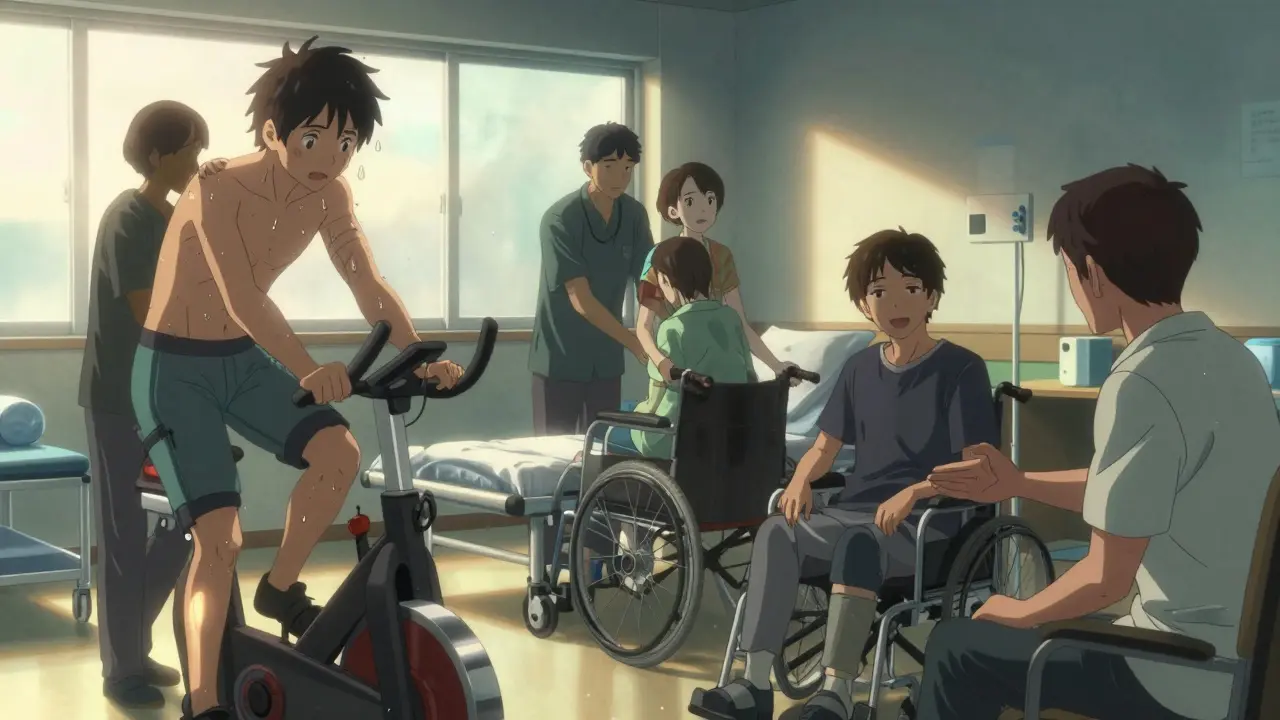
After the first week, rehab ramps up. You’ll spend at least three hours a day, five days a week, working with a team: physical therapists, occupational therapists, psychologists, nurses, and social workers. You’ll learn how to transfer from bed to wheelchair without injuring your shoulders-because 32% of caregivers get shoulder injuries from bad transfers. You’ll practice sitting up, balancing, and eventually standing with support. Treadmill training with body weight support is now standard. Studies show it improves walking speed 23% more than regular walking practice. It’s not magic-it’s science. The brain rewires itself when you repeatedly practice movement, even if your legs aren’t fully connected.
Assistive Devices: Tools That Restore Freedom
Assistive devices aren’t just gadgets-they’re lifelines. A manual wheelchair might be enough for someone with a lower injury. But if you have a high injury, you’ll need a power chair with sip-and-puff or head control. Custom seating systems can cost $1,200 to $3,500 out of pocket, even with Medicare covering 80%. Many people skip the best equipment because they can’t afford it.
For movement, robotic exoskeletons like Ekso and ReWalk let some people stand and take steps again. But they’re expensive, need three therapists to operate safely, and sessions are capped at 45 minutes because they drain your energy fast. One user on Reddit said his first steps in three years came from an exoskeleton-but progress was slow because he only got 25 minutes a day.
Functional Electrical Stimulation (FES) bikes are another game-changer. They send small electric pulses to paralyzed leg muscles, making them cycle. Users report better circulation, less muscle loss, and even improved bladder control. One person with a T6 injury said FES cycling kept his legs from wasting away-but the $5,000 home unit was too much to pay himself. Insurance rarely covers it fully.
For hands, robotic arms like Armeo help retrain grip and reach. Implantable diaphragm pacers, approved by the FDA in 2022, let some people with C3-C5 injuries breathe without a ventilator 74% of the time. These aren’t sci-fi-they’re real, and they’re changing lives.
What Works, What Doesn’t, and Why
Not all rehab methods are created equal. Treadmill training beats overground walking for walking recovery. FES cycling improves heart health better than arm cycling. Botulinum toxin injections reduce spasticity by 40-60% in most people. But here’s the catch: many high-tech tools lack long-term data. Only 37% of studies on exoskeletons follow patients beyond six months. That means we don’t know if they help long-term or just give a temporary boost.
Home exercise programs fail for 68% of people within six months. Why? No one checks in. No accountability. No motivation. The best programs pair you with a peer who’s been through it. At Spaulding Rehabilitation, 82% of patients said talking to someone else with SCI made them feel less alone and more willing to stick with rehab.
Spasticity management is another area where personalization matters. Some people do well with baclofen pills. Others need targeted Botox shots. One size doesn’t fit all. Same with bowel programs-some need suppositories, others need digital stimulation. It’s trial and error, and it takes time.

The Real Barriers: Money, Access, and Burnout
Even with the best rehab, the system fails people in quiet ways. Medicare covers 83% of actual rehab costs-meaning facilities lose money every time they treat someone. That’s why only 32% of general hospitals offer full SCI programs. You’re better off going to one of the 12% of centers that specialize in it-places like Mayo Clinic, Spaulding, or Shepherd Center.
Insurance denials are common. A $15,000 powered wheelchair might get approved, but the $3,000 custom cushion that prevents pressure sores? Denied. A $5,000 FES bike? Out-of-pocket. People give up. They go without. And that’s how preventable infections and hospital readmissions start.
Then there’s mental burnout. Rehab is exhausting. You’re learning to do everything differently. You’re grieving the life you had. Depression hits 40% of people in the first year. That’s why psychologists are part of every team. And why peer support isn’t a luxury-it’s essential. Talking to someone who gets it can be the difference between quitting and pushing forward.
What’s Next? The Future Is Here
Research is moving fast. Brain-computer interfaces are letting people with high injuries control robotic arms just by thinking. Early trials show 38% improvement in hand function. The Tethered Pelvic Assist Device (TPAD) helps with balance training. AI-driven therapy plans are now used in 65% of top centers by 2025, tailoring exercises to your progress in real time.
But technology won’t fix everything. The biggest challenge? Aging. Falls are the fastest-growing cause of SCI in people over 65. And as those injured decades ago get older, they face new problems: arthritis, weakened bones, and worn-out joints from decades of wheelchair use. The system isn’t ready for that wave.
What’s clear? Recovery isn’t about walking again. It’s about living well. It’s about being able to use the bathroom alone. To hug your kids without help. To get out of bed without someone lifting you. The tools, the therapy, the tech-they’re all just means to that end. And the best outcome? Not a miracle. Just independence.
Can you walk again after a spinal cord injury?
It depends on whether the injury is complete or incomplete. Only 1-3% of people with complete injuries regain walking ability. But 59% of those with incomplete injuries can walk again, often with assistive devices like exoskeletons or braces. Recovery is fastest in the first year, and treadmill training with body weight support significantly improves outcomes.
How long does spinal cord injury rehab last?
Rehab happens in phases. Acute rehab starts within days and lasts 6-12 weeks, focused on preventing complications. Subacute rehab continues for months, building strength and independence. Community reintegration begins around 3-6 months, with outpatient therapy continuing for years. Many people keep doing exercises and attending check-ups for life.
What are the most effective assistive devices for SCI?
The best devices depend on your injury level. For mobility: power wheelchairs, exoskeletons like Ekso or ReWalk, and FES bikes. For hand function: robotic arms like Armeo. For breathing: implantable diaphragm pacers for high cervical injuries. For daily living: adaptive tools for dressing, eating, and toileting. The key is matching the device to your specific needs-not what’s trendy.
Why do some people stop rehab after a few months?
The most common reasons are burnout, lack of motivation, and poor follow-up. Home exercise programs fail for 68% of people within six months because no one checks in. Insurance limits access to devices and therapy. Mental health struggles, like depression, also play a big role. Peer support programs dramatically improve long-term adherence.
Is spinal cord injury rehab covered by insurance?
Medicare and most private insurers cover inpatient rehab and basic equipment like wheelchairs, but often deny high-cost items like FES bikes or exoskeletons. Medicare covers 80% of wheelchair costs after deductible, leaving $1,200-$3,500 out of pocket for custom seating. Many devices require appeals, and even approved devices may only be covered for a limited time. Always check with your provider and advocate for necessary equipment.
brooke wright
January 15, 2026 AT 20:22I remember when I first got out of the hospital and tried to use a manual chair. My shoulders screamed for a week. No one told me how much it would hurt just to roll across the kitchen floor. I thought rehab was about walking again, but it’s really about learning how to not cry when you drop your fork for the 20th time and can’t pick it up.
And don’t even get me started on the damn catheter. You think you’re tough until you’re sobbing because you can’t figure out how to clean it without help. Then you realize you’re not broken-you’re just learning a new language your body doesn’t speak anymore.
Riya Katyal
January 16, 2026 AT 23:26Oh wow. So we’re just supposed to be *grateful* that we’re not dead? That’s the whole point of this post? Congrats, you wrote a 2000-word obituary for someone who’s still breathing.
Meanwhile, my cousin’s FES bike is gathering dust in his garage because insurance said ‘no’-again. But hey, at least he’s not quadriplegic, right? Progress!
Henry Ip
January 18, 2026 AT 01:16This is the most accurate breakdown I’ve seen. Treadmill training really does make a difference. I’ve seen people go from zero to standing with a walker in 8 weeks if they’re consistent. The key is showing up every day even when it sucks.
And yeah, the cost stuff? Real. My buddy got approved for a power chair but had to wait 11 months. By then his back was ruined from the manual one. Insurance doesn’t care about slow burns.
Also-FES bikes. Get one if you can. Even 15 minutes a day keeps your legs from turning to jelly. My therapist says it’s like retraining a muscle memory you didn’t know you still had.
waneta rozwan
January 19, 2026 AT 22:15Let me get this straight-you’re telling me the miracle cure for paralysis is… a $5000 bike that insurance won’t cover? And you think this is progress?
Meanwhile, people are dying because they can’t afford a cushion that prevents pressure sores. This isn’t science. This is capitalism with a shiny exoskeleton painted on top.
And don’t even mention ‘peer support.’ That’s just a Band-Aid on a hemorrhage. You don’t fix systemic neglect with a Reddit thread and a hug.
Cheryl Griffith
January 20, 2026 AT 11:02I’m a nurse who works in SCI rehab. I’ve seen the same stories play out for 12 years. The people who do best aren’t the ones with the fanciest gear. They’re the ones who have someone who shows up every day and says ‘I’m here’-not ‘I’m proud of you,’ not ‘you’re so strong,’ just ‘I’m here.’
One guy I worked with lost his wife to cancer right after his injury. He didn’t talk for six months. Then one day he just started doing his stretches while listening to jazz. No one pushed him. He just… did it. That’s the real magic. Not the tech. Not the money. Just showing up.
And yes, the burnout is real. I’ve watched people quit rehab because they couldn’t stand the pity in people’s eyes. Sometimes the hardest thing isn’t the paralysis-it’s the silence after you say ‘I’m fine.’
swarnima singh
January 21, 2026 AT 14:42we all know the truth... its not about walking again. its about not being a burden. its about not making your family cry when they see you in the chair. its about not being the ghost in your own home.
the tech is cool but its just a distraction. the real pain is the loneliness. the silence. the way people look at you like you're already gone.
and dont tell me about 'peer support'. i tried that. they all say 'you got this' but they dont get it. they never will.
we are the living dead. and the world keeps spinning like we're not here.
Isabella Reid
January 23, 2026 AT 13:09There’s something beautiful about how much we’ve learned about neuroplasticity in the last decade. It’s not just about fixing the spine-it’s about teaching the brain to find new paths. Like rerouting traffic after a bridge collapses.
And honestly? The fact that people are using brain-computer interfaces to move robotic arms with their thoughts? That’s not sci-fi. That’s Tuesday in a top rehab center.
But yeah, the money stuff? That’s the ugly part. Tech moves fast. Policy moves slow. And the people in the middle? They’re just trying to breathe through it all.
Joie Cregin
January 25, 2026 AT 00:47I got my first FES bike last year. It felt like my legs were remembering how to dance. Not walk-dance. Like they still remembered the rhythm of life before the crash.
My therapist said it’s not about strength. It’s about signaling. Like whispering to your nerves: ‘Hey, you’re still here. I haven’t forgotten you.’
And yeah, it cost me three months of my side gig. But I’d rather be broke than numb. My legs still feel something now. Even if it’s just a buzz. Even if it’s just for 20 minutes. It’s enough.
Also-my dog sits beside it like it’s a sacred altar. He knows something’s happening. He doesn’t need to understand. He just knows I’m not broken. I’m becoming.
Chelsea Harton
January 25, 2026 AT 10:46rehab is just a fancy word for learning to live with a body that betrayed you
vivek kumar
January 26, 2026 AT 09:56Let’s stop pretending this is about ‘recovery.’ This is about survival. The system doesn’t want you to heal-it wants you to be manageable. That’s why they cut your FES bike coverage. That’s why they push you out of rehab in 12 weeks. That’s why they call it ‘adaptive living’ instead of ‘rebuilding your life.’
And don’t tell me about ‘peer support.’ Peer support is what you get when the government gives up on you. It’s not a solution. It’s a consolation prize.
Real change? It’s not in the lab. It’s in the courtroom. It’s in the insurance appeals. It’s in the people who refuse to be invisible.
Nick Cole
January 28, 2026 AT 08:58Brooke, you’re not alone. I was in your shoes two years ago. The catheter thing? Yeah. I cried every time. Then I started doing it while listening to my daughter’s bedtime stories. Made it feel less clinical.
And Henry? You’re right about the treadmill. I went from 0 steps to 47 in 6 weeks. Not because I’m special. Because I showed up. Even on the days I wanted to quit.
And Waneta? You’re not wrong. The system’s broken. But we don’t fix it by giving up. We fix it by demanding more. And we demand more by living loud.