

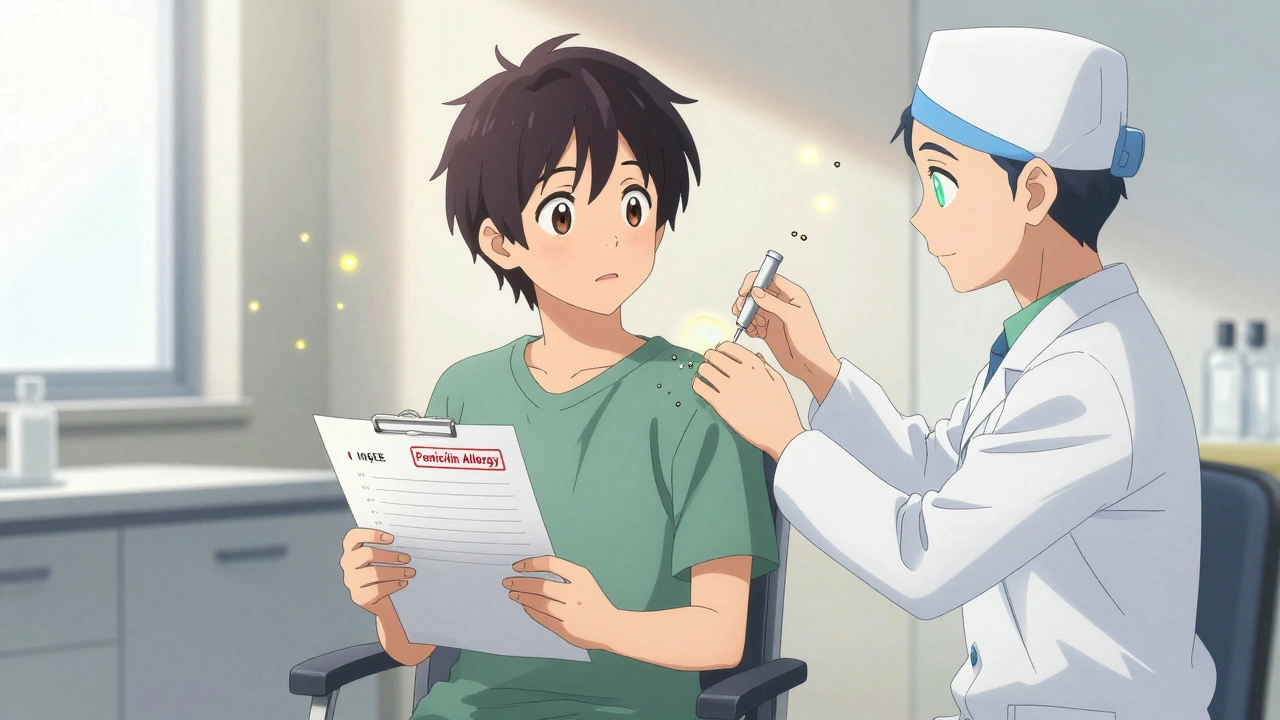
If you’ve ever been told you’re allergic to penicillin, you’re not alone. About 1 in 10 people in the U.S. say they are. But here’s the surprising part: 9 out of 10 of those people aren’t truly allergic. That’s not a guess - it’s what testing shows. And that misunderstanding is putting your health at risk - not because you’re reacting to penicillin, but because you’re being forced to use weaker, more dangerous antibiotics instead.
Why Most Penicillin Allergies Are Misdiagnosed
Penicillin is one of the oldest and most effective antibiotics. It’s been saving lives since the 1940s. But when someone gets a rash after taking it - maybe as a kid, maybe after a single dose - they’re often labeled allergic. That label sticks for life. Even if the rash was mild, even if it happened years ago, even if it was just a side effect like nausea or headache. The problem? Most reactions aren’t true allergies. A true penicillin allergy means your immune system mistakenly identifies the drug as a threat and attacks it. That’s rare. In fact, only about 1% of the population has a real IgE-mediated allergy. The rest? They were misdiagnosed, misunderstood, or just unlucky with a side effect. This isn’t just a personal issue. It’s a public health crisis. When doctors avoid penicillin because of a false allergy label, they turn to broader-spectrum antibiotics like vancomycin or clindamycin. These drugs kill more than just the bad bacteria. They wipe out good gut bacteria, which increases your risk of deadly infections like Clostridioides difficile - a superbug that causes severe diarrhea, hospitalization, and even death. Patients with fake penicillin allergies have a 50% higher chance of getting MRSA and a 35% higher chance of C. diff than those without the label.What a Real Penicillin Allergy Looks Like
Not all reactions are the same. There are two main types: immediate and delayed. Immediate reactions happen within an hour. These are the dangerous ones. They’re caused by IgE antibodies and can lead to anaphylaxis - a full-body allergic shock. Symptoms include:- Sudden swelling of the lips, tongue, or throat
- Wheezing or trouble breathing
- Rapid drop in blood pressure
- Dizziness, fainting, or loss of consciousness
- A flat, red rash that spreads over the body (maculopapular rash)
- Itching without visible rash
- Feeling tired, feverish, or swollen lymph nodes
How to Know If You’re Really Allergic
The only way to know for sure is testing. And it’s safer than you think. Step 1: Skin testing - This is done by an allergist. Tiny amounts of penicillin and its breakdown products (called major and minor determinants) are placed under your skin with a tiny needle. If you’re truly allergic, a red, itchy bump appears within 15-20 minutes. This test is over 95% accurate. Step 2: Oral challenge - If the skin test is negative, you’re given a small dose of amoxicillin (a penicillin-type drug) and watched for an hour. No reaction? You’re not allergic. You can safely take penicillin again. The whole process takes less than two hours. The risk? Extremely low. Studies show that after a negative skin test and oral challenge, your risk of anaphylaxis drops to near zero - the same as someone who’s never claimed to be allergic. And here’s the kicker: 80% of people who had an IgE-mediated reaction 10 years ago no longer react to penicillin. Your allergy can go away. But if no one tests you, you’ll carry the label forever.
Who Can Skip Testing - And Who Can’t
Not everyone needs a full allergy workup. Doctors use risk categories to decide who needs testing and who doesn’t. Low-risk patients - About 60% of people with a penicillin label fall here. These are people who:- Had a rash more than 5 years ago
- Only had nausea, diarrhea, or headache
- Never had swelling, trouble breathing, or anaphylaxis
- Are unsure when or how the allergy happened
- Urticaria (hives) within the last 5 years
- Facial or throat swelling
- Respiratory symptoms like wheezing
- Anaphylaxis within the last 10 years
- Stevens-Johnson Syndrome (SJS) or Toxic Epidermal Necrolysis (TEN)
- Drug Reaction with Eosinophilia and Systemic Symptoms (DRESS)
What Happens After You’re Cleared
If you pass the test, you’re not just “allowed” to take penicillin again - you’re freed from unnecessary risks. Your doctor will update your medical record. You’ll get a letter or form to keep with your meds. And you should consider wearing a medical alert bracelet - not because you’re allergic, but because you used to be mislabeled. That way, if you’re ever in the ER unconscious, they won’t give you a risky alternative. You’ll also be able to take safer, cheaper, more effective antibiotics in the future. For example, if you need antibiotics for a sinus infection, strep throat, or Lyme disease, penicillin is still the top choice. It’s targeted. It doesn’t wreck your gut. And it costs pennies compared to the alternatives.
What to Do If You Think You’re Allergic
Here’s your action plan:- Look at your medical records. What exactly was the reaction? When? How severe?
- Ask your doctor: “Was this tested? Or was it just assumed?”
- If it was a mild rash years ago or just stomach upset - ask for a referral to an allergist for testing.
- If you had swelling, breathing trouble, or anaphylaxis - don’t wait. See an allergist.
- Don’t avoid penicillin just because your parent or sibling had an allergy. Allergies aren’t inherited like eye color.
The Bigger Picture: Why This Matters for Everyone
This isn’t just about you. It’s about all of us. Every time a doctor gives you vancomycin instead of penicillin because of a false allergy, they’re contributing to antibiotic resistance. These stronger drugs are used as a last resort. When we overuse them, bacteria evolve. And then they become untreatable. Hospitals that run formal penicillin allergy de-labeling programs have removed incorrect labels from 80-90% of patients. That means fewer infections, shorter hospital stays, and lower costs. The CDC estimates this could save the U.S. healthcare system $1.2 billion a year. In surgery, using the right antibiotic - like cefazolin - cuts infection rates by half. But if you’re mislabeled, you might get clindamycin instead. That’s less effective. And it increases your chance of getting a surgical site infection by 30%.Final Thoughts
You don’t have to live with a label that’s holding you back. If you’ve been told you’re allergic to penicillin, ask: Was this confirmed? Or just assumed? Testing is safe, fast, and accurate. And if you’re cleared, you’ll get better care - for the rest of your life. Don’t wait until you’re sick again. Don’t let a childhood rash decide your future antibiotics. Get tested. Get cleared. Stay safe.Can I outgrow a penicillin allergy?
Yes. About 80% of people who had a true IgE-mediated penicillin allergy lose their sensitivity after 10 years without exposure. Even if you had a serious reaction as a child, you may no longer be allergic. Testing is the only way to know for sure.
Are cephalosporins safe if I’m allergic to penicillin?
For most people, yes. If you never had a severe IgE-mediated reaction like anaphylaxis or swelling, you can safely take first-generation cephalosporins like cefazolin. Even third- and fourth-generation cephalosporins and carbapenems are considered safe for those without a history of IgE-mediated symptoms. The risk is very low - less than 2%.
Can I take amoxicillin if I’m allergic to penicillin?
Amoxicillin is a type of penicillin. If you have a true penicillin allergy, you should avoid it. But if you were mislabeled - which most people are - you can safely take it after a negative skin test and oral challenge. Many allergists use amoxicillin as the challenge drug because it’s well-tolerated and highly accurate.
What should I do if I have a reaction to penicillin?
If you have swelling of the face, lips, or throat, trouble breathing, dizziness, or a rapid heartbeat - call 911 or go to the emergency room immediately. These are signs of anaphylaxis. For mild rashes or stomach upset, stop the drug and call your doctor. Don’t assume it’s just a side effect - get it evaluated properly.
Is penicillin allergy testing covered by insurance?
Yes, in most cases. Allergy testing for penicillin is considered medically necessary by major insurers, including Medicare and Medicaid. The cost is usually under $200, and many clinics offer it as part of routine outpatient care. Ask your doctor or allergist to verify coverage before your appointment.
Can I be tested if I’m pregnant?
Yes. Penicillin is the safest antibiotic for treating infections during pregnancy - like Group B Strep or syphilis. If you’re labeled allergic, you may be given a less effective drug, which increases risks for you and your baby. Skin testing and oral challenges are safe during pregnancy and recommended by the CDC for pregnant women with a penicillin allergy label.
What if I’ve never taken penicillin but my family says I’m allergic?
Family history doesn’t determine your allergy. Penicillin allergies aren’t inherited. If you’ve never taken it and never had a reaction, you’re not allergic. Don’t assume you are. Only get tested if you’ve actually had a reaction - and even then, it might not be real. Many people are mislabeled based on secondhand stories.
Sarah Gray
December 9, 2025 AT 09:44Let’s be clear: the medical establishment has been catastrophically negligent in labeling penicillin allergies for decades. The data is irrefutable - 90% of these labels are erroneous. Yet, we still see patients being denied first-line antibiotics based on a childhood rash or a misinterpreted nausea episode. This isn’t just incompetence - it’s systemic malpractice disguised as caution. The CDC’s own figures confirm this is a $1.2 billion annual error. And yet, most primary care providers still don’t refer patients for testing. Why? Because it’s easier to just write ‘penicillin allergy’ and move on. Until we hold clinicians accountable for lazy diagnostics, this will keep happening.
And don’t get me started on the fact that many patients still believe allergies are hereditary. That’s pseudoscience wrapped in anecdote. You cannot inherit a penicillin allergy. You can inherit a predisposition to immune dysregulation - but that’s not the same thing. Stop passing down medical myths like family recipes.
Also, if you’re reading this and you’ve been told you’re allergic - go get tested. It’s a two-hour process. The cost is less than your monthly coffee habit. And you might just save your future self from vancomycin-induced C. diff. The burden of proof is not on you to prove you’re *not* allergic. It’s on the system to prove you are. And it rarely does.
Kathy Haverly
December 9, 2025 AT 12:36Oh please. You’re telling me that a rash that lasted three days and made me itch for a week isn’t an allergy? That’s not a side effect - that’s your body screaming at you. And now you want me to trust some allergist with a needle and a placebo pill? I’ve seen people go into anaphylaxis after being told they were ‘fine.’ You don’t get to dismiss real reactions because your data says they’re rare. The fact that it’s statistically uncommon doesn’t mean it’s not real for the person it happens to. And if you think I’m going to risk my life because some study says I probably won’t die - you’re delusional.
Also, who authorized you to speak for everyone? My cousin died because they were given penicillin after being ‘cleared’ by some clinic. You think that’s just a statistic? It’s a funeral. So don’t you dare tell me to ‘just get tested.’ Some of us have seen the other side of your ‘safe’ protocols.
Graham Abbas
December 10, 2025 AT 22:27This is one of those rare moments where science and common sense converge in a way that feels almost poetic. We’ve built a medical culture around fear - fear of liability, fear of the unknown, fear of being wrong. And so we blanket entire populations with labels that stick like tar, even when the evidence evaporates. Penicillin is a miracle drug - it’s the pen that wrote the modern chapter of medicine. And yet, we treat it like a toxic relic because someone’s aunt had a rash in 1972.
What’s fascinating is how deeply we cling to identity through medical labels. ‘I’m allergic to penicillin’ becomes part of your personal narrative. To remove it feels like erasing a part of your history. But here’s the truth: your body doesn’t remember what your chart does. It forgets. It adapts. It moves on. And we, as a society, are so terrified of change that we’d rather keep a false identity than risk the vulnerability of being re-evaluated.
Testing isn’t just medical - it’s existential. It asks you: Are you still the person you were ten years ago? Or are you someone who’s grown, healed, changed? Maybe the real allergy isn’t to the drug - it’s to the idea that we can evolve.
Haley P Law
December 12, 2025 AT 11:56OMG I JUST FOUND OUT I’M NOT ALLERGIC??? 😭 I’ve been avoiding all antibiotics since I was 7 because I got a rash after amoxicillin. My mom still says ‘I told you not to take it!’ like it’s a moral failure. I just got tested yesterday and the allergist said I’m fine. I cried in the parking lot. I’m getting a bracelet that says ‘NOT ALLERGIC TO PENICILLIN’ now. I’m so mad I wasted 20 years of my life being scared of a label. Also I just took amoxicillin for a sinus infection and I’m fine. Like… I’m alive. I’m breathing. I didn’t die. Who knew?
PS: If you’re reading this and you think you’re allergic - just go. It’s not scary. I did it on a Tuesday. I got a snack afterward. Life changed.
PPS: My doctor didn’t even know about this testing. So I had to Google it. That’s wild.
Andrea DeWinter
December 14, 2025 AT 10:49If you’ve been told you’re allergic to penicillin and you’re not sure - please talk to your doctor. Seriously. Don’t wait until you’re sick. Don’t wait until your kid has strep throat and the doctor says ‘we’ll use azithromycin instead’ - because that’s not better. It’s more expensive, harder on your gut, and less effective. Testing is easy. It’s covered. It’s safe. I’ve seen it in my clinic - people come in terrified, leave relieved. One woman told me she’d been avoiding all antibiotics for 30 years because her brother had a reaction. She had never even taken penicillin. That’s not an allergy - that’s a family myth. We need to stop treating medical labels like family heirlooms. They’re not sacred. They’re data. And data can be updated.
Also - if you’re pregnant? Get tested. Penicillin is the safest thing for you and your baby. Don’t let fear make decisions for you. You deserve better care. And you’re not alone in this. Many of us have been there. You’re not crazy. You’re just misinformed. Let’s fix that together.
Chris Marel
December 15, 2025 AT 20:28I come from a place where antibiotics are still a luxury. In my village, we don’t have allergists. We don’t have skin tests. We take what’s given. But I’ve seen people die because they were given the wrong drug - not because they were allergic, but because no one knew what else to give. So when I read this, I felt both hope and sorrow. Hope because I finally understand why some people get sicker after antibiotics. Sorrow because so many never get the chance to be tested.
I’m not saying everyone should rush to get tested. But I’m saying - if you have access, use it. Not just for yourself. For your family. For the next person who might need penicillin and can’t get it because someone’s outdated label is still in the system. You’re not just changing your own story. You’re changing someone else’s chance to live.
precious amzy
December 17, 2025 AT 07:45One must interrogate the epistemological foundations of this so-called ‘de-labeling’ movement. The assertion that 90% of penicillin allergies are ‘misdiagnosed’ presumes a monolithic, positivist model of medical truth - one that dismisses phenomenological experience in favor of statistical aggregates. The patient’s lived reality - the rash, the nausea, the visceral dread - is reduced to a ‘side effect’ by a clinical hierarchy that privileges quantification over subjectivity. This is not science. It is scientism.
Moreover, the normalization of oral challenges as ‘safe’ ignores the ontological risk of medicalization: the body becomes a site of protocol, not autonomy. Who authorizes the physician to reclassify your bodily memory? The CDC? A 2018 meta-analysis? Where is the consent in this erasure? You do not ‘outgrow’ an allergy - you are coerced into forgetting it.
And let us not forget: the financial incentive for hospitals to ‘de-label’ patients is not incidental. It is systemic. This is not healthcare reform. It is cost optimization dressed in white coats. Beware the seduction of efficiency.
William Umstattd
December 19, 2025 AT 03:00Let me be perfectly clear - if you’re one of those people who thinks a rash equals ‘allergy’ and then casually shrugs it off as ‘probably not real,’ you’re part of the problem. You’re not helping. You’re enabling. You’re the reason people die. You’re the reason hospitals have to use vancomycin like it’s candy. You’re the reason MRSA is spreading like wildfire because you think your cousin’s ‘mild’ reaction doesn’t count.
There’s a difference between ‘I think I might’ve been allergic’ and ‘I had a reaction.’ The latter demands respect. The former demands education. And if you’re the type to say ‘oh I’m sure I’m fine’ after a documented rash - you’re not brave. You’re reckless. You’re not saving money. You’re gambling with your life and everyone around you.
And don’t give me that ‘it’s just a label’ nonsense. Labels save lives. If you’re allergic - you’re allergic. If you’re not - get tested. But don’t pretend you know more than your immune system just because you read an article. That’s not confidence. That’s arrogance. And arrogance kills.
Tejas Bubane
December 19, 2025 AT 14:21Bro I got labeled allergic at 12 after eating a penicillin pill I found in my mom’s drawer (don’t ask). Never took it again. 15 years later I go to urgent care for pneumonia and they give me amoxicillin. I’m like ‘wait I’m allergic’ and they’re like ‘nah you’re not.’ I took it. No reaction. I’m alive. It’s wild how dumb this whole system is. I didn’t even know you could get tested. My doctor didn’t mention it. I had to Google it myself. So yeah - if you think you’re allergic, just ask. It’s not a big deal. Stop overthinking it. And stop letting your grandma’s old story decide your antibiotics. 😅