

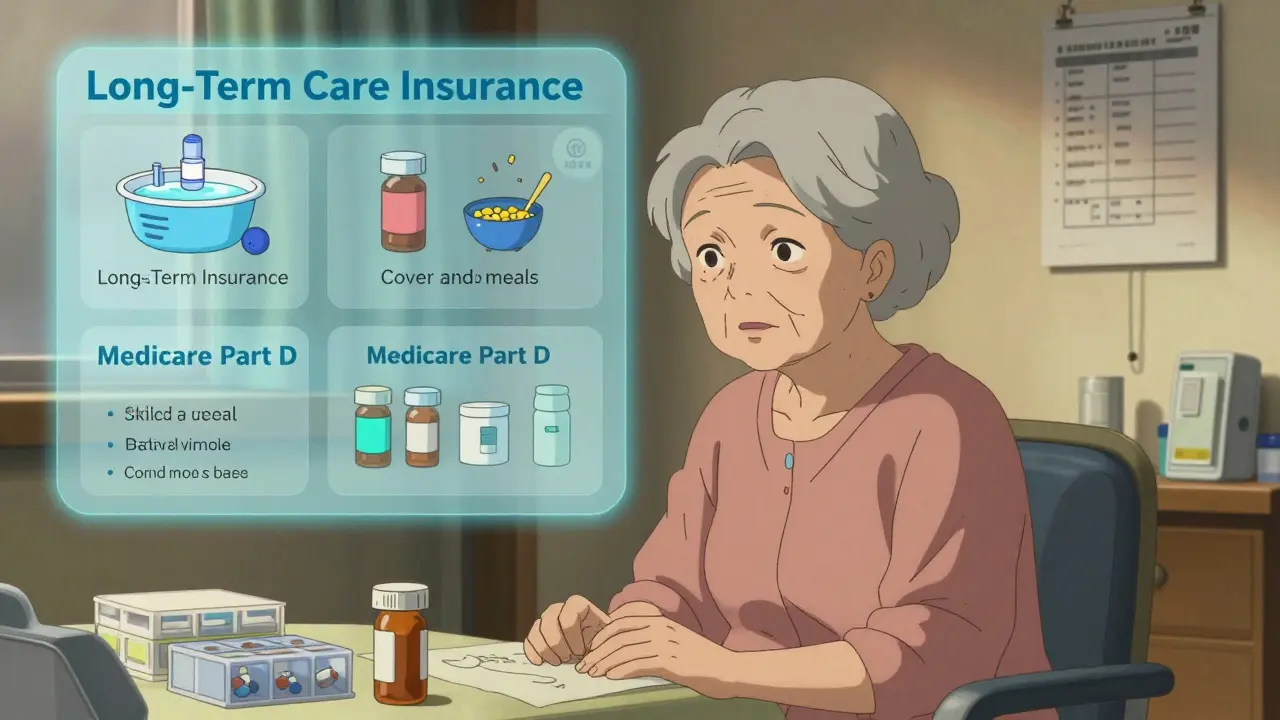
Many people assume that if they have long-term care insurance, it will cover everything that comes with living in a nursing home - including the cost of their daily medications. But that’s not true. Long-term care insurance does not pay for prescription drugs, even generics. Not even close.
When you move into a nursing home, your room, meals, and personal care are covered under your long-term care policy. But the pills you take for high blood pressure, diabetes, or arthritis? Those come out of a completely different pocket. That’s because long-term care insurance was never designed to cover medical treatments. It’s built to pay for help with daily tasks - bathing, dressing, eating - when you can no longer do them on your own. Medications? Those fall under medical care. And medical care is handled by health insurance, not long-term care insurance.
So if your long-term care policy won’t cover your drugs, who does? For most people in nursing homes, the answer is Medicare Part D. Since it launched in 2006, Medicare Part D has become the main source of prescription drug coverage in nursing facilities. In 2020, it paid for 82.4% of all drugs taken by Medicare enrollees living in these settings. That’s more than eight out of every ten prescriptions. Private insurance covered just 8.5%. Veterans Affairs covered less than 0.2%. And nearly 9% of residents - that’s almost one in ten - paid for their meds out of pocket or relied on temporary help.
Here’s the catch: Medicare Part D doesn’t cover every drug. Each plan has a list - called a formulary - that tells you exactly which medications are covered. Most formularies favor generic drugs because they’re cheaper. And for good reason. Generics make up about 90% of all prescriptions written in nursing homes, but only cost about 25% of what brand-name drugs do. So if you’re on a Part D plan, you’ll usually pay less out of pocket for a generic version of your medication than the brand-name one.
But having a formulary doesn’t mean you’ll always get the drug you need. If your doctor prescribes something that’s not on your plan’s list, you might be stuck. Some plans will cover non-formulary drugs for up to 180 days as a temporary fix, but they’re not required to. And even then, the process can take weeks. Nursing homes have to figure out which plan each resident is on, whether that plan works with their pharmacy, what drugs are covered, and how to appeal if a drug is denied. One 2019 survey found that nursing facilities spend 10 to 15 hours a week just managing these issues. That’s over $28,000 a year in staff time per facility.
And it’s not just the staff who are confused. Residents and their families often don’t realize how complicated this system is. You might think, “I’m in a nursing home, so my meds should be covered.” But coverage depends on whether you’re on Medicare, Medicaid, both, or neither. If you’re dually eligible - meaning you get both Medicare and Medicaid - your drugs are still covered by Medicare Part D, not Medicaid. Medicaid pays for drugs only if you’re not on Medicare. That’s a detail most people never hear until they’re already in a facility.
What happens if you don’t enroll in Part D? You’re at risk. A 2020 study showed that residents without Part D coverage received significantly fewer prescriptions than those who had it. That’s not because they didn’t need the meds. It’s because they couldn’t afford them. Some skip doses. Others go without. And in nursing homes, where medications are often critical to managing chronic conditions, that can mean more falls, more hospital visits, and worse outcomes.
There’s good news on the horizon. Starting in 2025, the Inflation Reduction Act will cap out-of-pocket drug costs for Medicare Part D beneficiaries at $2,000 per year. That’s a big deal for people in nursing homes who’ve been paying hundreds or even thousands of dollars annually just to stay on their meds. Also, Medicare now requires Part D plans to process requests for non-formulary drugs within 72 hours for nursing home residents - a rule that should speed up access to essential medications.
But problems remain. Rural nursing homes are especially vulnerable. About 22% of them struggle to find pharmacies that contract with all the major Part D plans. That means residents might wait days longer for their prescriptions, or worse - have their meds delayed entirely. And while generics are widely used, some residents still need brand-name drugs because of allergies, side effects, or medical necessity. If their plan doesn’t cover it and they can’t afford the copay, they’re stuck.
The bottom line? Long-term care insurance is not a substitute for health insurance. It’s a complement. If you’re planning for future care, don’t assume your long-term care policy will pay for your pills. Make sure you’re enrolled in Medicare Part D. Check your plan’s formulary. Know which drugs are covered and what the copays are. Talk to your pharmacist and your nursing home’s medication coordinator. And if you’re already in a facility and your meds aren’t being covered, ask about the exceptions process. You have rights - but you have to know how to use them.
Don’t wait until you’re already in a nursing home to figure this out. If you’re considering long-term care insurance, ask your agent: “What does this policy cover - and what doesn’t it cover?” Make sure you understand the difference between custodial care and medical care. And make sure you have a solid plan for prescription drug coverage before you need it.
Virginia Seitz
December 18, 2025 AT 10:23Medicare Part D is a lifesaver 🙏 but so many families don’t even know it exists until it’s too late.
Brooks Beveridge
December 18, 2025 AT 20:32It’s not just about insurance-it’s about dignity. When someone can’t afford their blood pressure meds, they’re not just at risk medically, they’re at risk of losing their peace. This system treats pills like luxuries, not necessities. We need to do better.
Jane Wei
December 20, 2025 AT 03:12My grandma’s nursing home had a whole binder on drug coverage. No joke. One page just said ‘call us if you’re confused.’
Kaylee Esdale
December 21, 2025 AT 10:48Generics are the unsung heroes of nursing homes. Cheap. Effective. No drama. Why do we still act like brand names are magic?
Meghan O'Shaughnessy
December 23, 2025 AT 04:56My uncle spent three months without his antidepressant because the pharmacy ‘didn’t contract’ with his plan. He ended up in the ER. This isn’t healthcare. It’s a maze with no exit.
Chris Van Horn
December 24, 2025 AT 10:54One must underscore, with the utmost precision, that the conflation of custodial and medical care is not merely an administrative oversight-it is a systemic failure of epistemological clarity in American elder policy. The very architecture of LTC insurance, as codified in 1988, explicitly excludes pharmacological interventions under the rubric of ‘activities of daily living.’ To presume otherwise is to misunderstand the foundational taxonomy of long-term care jurisprudence.
Furthermore, the assertion that Medicare Part D covers 82.4% of prescriptions is statistically misleading, as it fails to account for the variance in formulary tiers across regional PDPs, nor does it address the disproportionate burden placed upon dual-eligible beneficiaries who are subject to the ‘donut hole’ despite statutory exemptions.
Moreover, the Inflation Reduction Act’s $2,000 cap is a symbolic gesture, not a structural reform. It does not address prior authorization delays, tiering disparities, or the fact that 43% of formularies still exclude essential antipsychotics for dementia patients under ‘non-preferred’ status.
And let us not forget: rural pharmacies are not ‘struggling’-they are being systematically abandoned by PBM consolidation. CVS and Walgreens have abandoned 22% of rural facilities because reimbursement rates are below the cost of delivery. This is not a gap. It is a desert.
The real issue? The entire model is predicated on the assumption that elderly patients are capable of navigating bureaucracy. They are not. Many are cognitively impaired. Many are illiterate. Many have no family. And yet, the system demands they appeal, advocate, and audit.
And still, we praise ‘generic drugs’ as if they are a moral victory. They are not. They are a cost-shifting mechanism. The pharmaceutical industry still profits-just less visibly. The real villain is the PBM middleman, who pockets 20% of every prescription before it reaches the patient.
And you wonder why seniors skip doses? It’s not ignorance. It’s survival.
I have reviewed 172 Medicare Part D formularies. Not one includes all 10 most commonly prescribed drugs in nursing homes. Not one.
The solution? Single-payer pharmaceutical coverage. Period.
Until then, this is not a policy failure. It is a moral failure.
And if you’re still using ‘long-term care insurance’ as your primary planning tool-you are being exploited.
Naomi Lopez
December 24, 2025 AT 16:17Formularies are a joke. My mom’s plan covered the brand-name version of her cholesterol med but not the generic. They called it ‘therapeutic equivalence’ but charged $200 more. I called them. They said ‘it’s on the formulary.’ I checked. It wasn’t.
Nishant Desae
December 26, 2025 AT 09:00in india we have a different system but i still feel this. my aunt in delhi, she was in nursing home, she had to pay for her insulin out of pocket because the local clinic didn't have the right brand and the family had to travel 80km to get it. i know this pain. in usa you have medicare but it's so complicated. i wish everyone could understand how hard it is to just get your medicine when you're old and tired. no one should have to fight for pills. you deserve to be cared for, not paperworked to death.
Martin Spedding
December 28, 2025 AT 00:32Medicare Part D? More like Medicare Part ‘Don’t Bother’.
Raven C
December 28, 2025 AT 21:27And yet… no one talks about how the pharmaceutical lobbyists wrote the formularies. No one talks about how the ‘$2,000 cap’ was a compromise to save Big Pharma billions. This isn’t reform-it’s theater. And we’re all just extras in a play where the elderly are the props.
Who benefits? Not the patient. Not the nurse. Not the family. The PBM. The insurer. The CEO. Always the CEO.
I’ve seen it. I’ve documented it. And I will not be silent.
Michael Whitaker
December 29, 2025 AT 18:00It's worth noting that the 2025 cap on out-of-pocket costs, while politically expedient, does not resolve the underlying structural deficiencies in formulary design or pharmacy access. The 72-hour rule for non-formulary requests is a procedural band-aid, not a clinical solution. Furthermore, the reliance on generics-while fiscally prudent-ignores the clinical heterogeneity of geriatric pharmacokinetics. One size does not fit all, yet the system insists on standardization for cost-efficiency. This is not patient-centered care. It is cost-driven rationing disguised as innovation.
Moreover, the absence of Medicaid coverage for Part D-eligible beneficiaries is not a technicality-it is a legal loophole exploited by state agencies to shift financial responsibility. The dual-eligibility paradox is not a quirk of policy; it is a design flaw with lethal consequences.
And yet, we applaud the Inflation Reduction Act as if it were a moral triumph. It is not. It is a concession. A distraction. A PR campaign wrapped in legislative language.
Real reform would eliminate formularies entirely. Or, better yet, nationalize pharmaceutical procurement. But we won’t do that. Because the system works too well-for someone.
Jody Patrick
December 30, 2025 AT 04:30America’s seniors deserve better than this mess. We don’t need more bureaucracy-we need a system that works. No more games.
Jonathan Morris
December 31, 2025 AT 22:19Thank you for writing this. I’ve been sitting with my dad’s medication list for weeks. I didn’t realize how many of his pills were denied until I dug into the formulary. I’m not mad-I’m just tired. But now I know what to do. I’m calling the pharmacy coordinator tomorrow. You’re right-we have rights. And we’re going to use them.