


Giving a child or a loved one liquid medicine might seem simple, but a small mistake in reading a label can lead to a dangerous situation. In the US alone, medication errors cause about 1.3 million injuries every year. When it comes to liquids, the risk is even higher because we often confuse the amount of medicine in the bottle with the amount we need to give. If you've ever stared at a label and wondered if you should use a kitchen spoon or a plastic cup, you aren't alone. The goal is simple: get the exact right dose every single time to ensure the medicine works and the patient stays safe.
Quick Guide to Liquid Medication Safety
- Always use milliliters (mL): Ignore teaspoons and tablespoons; they are too inconsistent.
- Check the concentration: Understand how much active drug is in each mL.
- Use the provided tool: Only use the syringe or cup that came with the medicine.
- Watch the decimals: 0.5 mL is very different from 5 mL.
- Confirm with a pro: If the label is blurry or confusing, call your pharmacist immediately.
The Gold Standard: Why Milliliters (mL) Matter
For years, many of us were told to give a "teaspoon" of syrup. The problem is that your favorite kitchen spoon isn't a measuring tool. Research shows that household spoons can vary by 20% to 200% in volume. Some "teaspoons" hold 2.5 mL, while others hold up to 7.5 mL. That kind of gap can lead to a massive underdose or a toxic overdose.
Because of this, the National Council for Prescription Drug Programs (NCPDP) and the FDA now push for milliliters as the only acceptable unit of measure on liquid prescription labels. A milliliter is a precise metric unit that doesn't change regardless of which country you're in or what spoon you own. In fact, using mL-only labeling has been shown to cut administration errors by over 50%.
Breaking Down the Label: Three Things You Must Find
When you pick up a bottle, don't just look for the number. You need to identify three distinct pieces of information to avoid the common mistake of confusing volume with dose.
1. The Concentration (The "Strength")
This is often the most confusing part. You'll see something like concentration listed as "240 mg/5 mL." This does not mean you should give 5 mL. It means that for every 5 mL of liquid, there are 240 milligrams of the actual drug. If your doctor prescribes a 120 mg dose, you would actually only give 2.5 mL.
2. The Dosage Instructions (The "How Much")
This is the specific amount you need to administer. It should be written clearly, such as "Take 10 mL twice daily." A huge red flag is the use of "trailing zeros." According to a Johns Hopkins study, writing "5.0 mL" instead of "5 mL" can lead to errors where the decimal is missed and the patient gets 50 mL. Always look for a leading zero (e.g., 0.5 mL) and no trailing zero.
3. Total Container Volume
You might see "118 mL" or "237 mL" printed on the bottle. This is simply how much liquid is in the entire bottle. Never mistake this for the dose. Some people see the total volume and accidentally administer way too much because they confuse the bottle's capacity with the required dose.
| Common Term | Standard Metric Value | Household Spoon Variance | Risk Level |
|---|---|---|---|
| 1/2 Teaspoon | 2.5 mL | High (2.5 - 7.5 mL) | Dangerous |
| 1 Teaspoon | 5 mL | High (2.5 - 7.5 mL) | Dangerous |
| 1 Tablespoon | 15 mL | Extreme (5 - 20 mL) | Very Dangerous |
| Oral Syringe/Cup | Exact mL | None (Calibrated) | Safe |
How to Measure Without Mistakes
Having the right label is only half the battle. You need the right tool to actually move the liquid from the bottle to the patient. If the pharmacy didn't give you a measuring device, ask for one. Using a generic cup from the kitchen is a recipe for disaster.
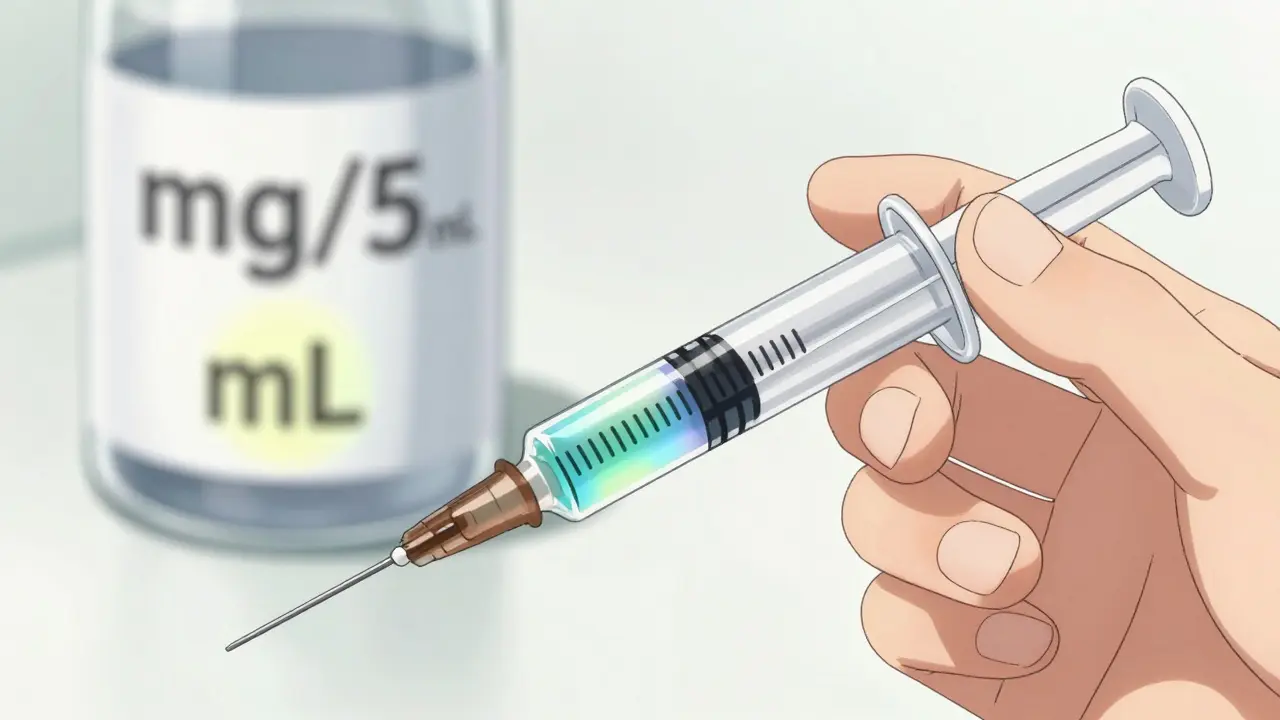
For infants or very small doses (like 0.8 mL), an oral syringe is the only way to go. Syringes allow you to pull the liquid up to a precise line, eliminating the "spill factor" and the air gaps found in cups. When using a cup, always place it on a flat surface and read the measurement at eye level. If you tilt the cup or hold it in the air, you'll likely get an inaccurate reading.

Common Pitfalls and How to Avoid Them
Even with clear labels, mistakes happen. One of the biggest issues is health literacy-simply not understanding the medical terminology. For example, some parents see "240 mg/5 mL" and assume the "5 mL" is the dose they should give, regardless of what the doctor actually ordered.
To stop this from happening, use the "teach-back" method. When the pharmacist explains the dose to you, explain it back to them in your own words. Say, "So, I need to use the syringe to pull up exactly 2.5 mL, which gives my child 120 mg of the drug, and I do this twice a day?" If you can explain it correctly, you're much less likely to make a mistake at home. This simple habit can reduce errors by over 60%.
When to Call Your Pharmacist
Don't guess. If any of the following are true, stop and call your healthcare provider:
- The label is smudged, torn, or the ink has faded.
- The dose is written as a fraction (like 1/2 tsp) but your measuring tool only has mL.
- The decimal point is missing or looks like a stray mark.
- You aren't sure if the concentration (e.g., mg/mL) matches the dose ordered by the doctor.
Can I use a kitchen spoon if I lost my measuring cup?
No. Household spoons are not standardized. A "teaspoon" from your drawer could hold anywhere from 2.5 mL to 7.5 mL. This variance is too high for medication and could lead to an accidental overdose or underdose. Always get a replacement oral syringe or cup from your pharmacy.
What does "mg/5 mL" actually mean?
This is the concentration. It tells you how much of the active medication (in milligrams) is dissolved in 5 milliliters of the liquid. It is a ratio, not the dose. To find your actual dose, you must look at the instructions (e.g., "Take 2 mL"), not the concentration ratio.
Why is it written as 0.5 mL instead of .5 mL?
The "leading zero" is a safety standard. If a label says ".5 mL" and the decimal point is faint or ignored, a caregiver might read it as "5 mL," giving ten times the intended dose. Adding the zero (0.5 mL) makes the decimal point obvious and prevents these dangerous 10-fold errors.
Is a tablespoon the same as 15 mL?
In a medical standard, 1 tablespoon is exactly 15 mL. However, a physical tablespoon from your kitchen can vary wildly, sometimes holding 5 mL or as much as 20 mL. For this reason, medical professionals insist on using mL measurements and calibrated devices rather than "tablespoons."
What should I do if the dose on the label seems too high?
Stop immediately and call your pharmacist or doctor. Do not administer the medicine if the dose seems unusual or different from previous prescriptions. Confirm the concentration and the patient's weight with the provider to ensure the dosage is correct for the specific individual.