

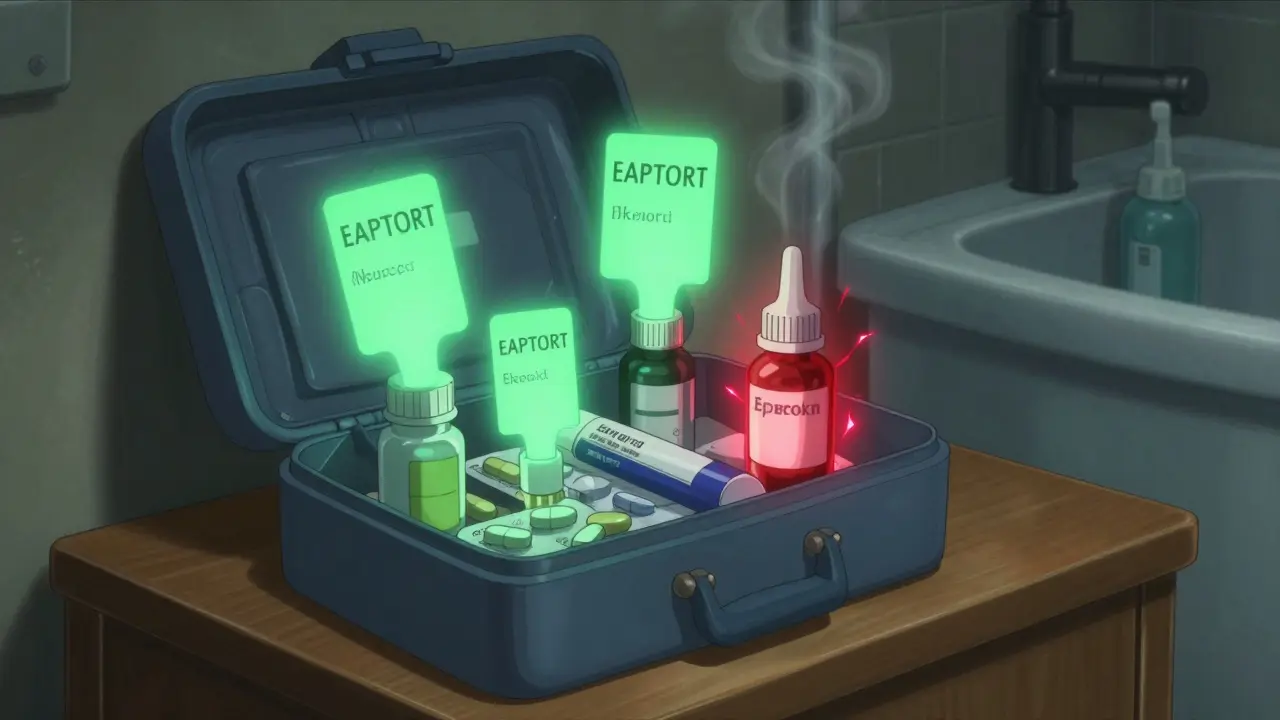
Most people keep a first-aid kit at home, but how many of them actually check what’s inside? By the time an emergency happens, it’s too late to find out your pain reliever has lost its punch or your epinephrine pen won’t work. The truth is, expired OTC first-aid medications aren’t always dangerous-but they can be useless. And in a crisis, useless is just as bad as harmful.
Not All Expired Medications Are the Same
Think of your first-aid kit like a toolbox. Some tools rust, some just get dull. Solid pills like ibuprofen or acetaminophen? They’re like a hammer-slow to degrade. Studies show that when stored properly in a cool, dry place, these pain relievers often keep 90% of their potency for years past their printed expiration date. A 2019 U.S. Department of Defense study found that 80% of tested samples still worked well even 15 years later.
But that doesn’t mean you should use anything old. Liquid medications? They’re more like a spray can of paint. Once opened, they start breaking down fast. Eye drops, antibiotic suspensions, and especially epinephrine auto-injectors (EpiPens) lose effectiveness within months after expiration. The FDA specifically warns against using these past their date. Why? Because in an allergic reaction, half a dose might not be enough to save a life.
The Real Danger Zone: Emergency Medications
If your first-aid kit has any of these, treat them like a smoke alarm-with a hard expiration date:
- Epinephrine (EpiPen): Loses 20-30% potency within 6 months after expiration. A 2021 study in the Journal of Allergy and Clinical Immunology found that expired pens often deliver less than half the needed dose. In real-world cases, people have survived allergic reactions using expired pens-but only after multiple injections and still needing emergency care.
- Nitroglycerine tablets: Used for chest pain. These tablets oxidize quickly once the bottle is opened. Even if the date is still good, replace them every 3-6 months after opening. A single weak tablet could mean the difference between stopping a heart attack and waiting for an ambulance.
- Liquid antibiotics: Bacterial growth can happen in old suspensions. The FDA has linked expired liquid antibiotics to treatment failures and antibiotic resistance. If it’s cloudy, smells odd, or has particles, toss it-even if the date is still valid.
- Eye and ear drops: These are sterile. Once expired, they’re no longer safe. A 2023 FDA lab test found 47% of expired hydrocortisone eye creams showed signs of contamination.
- Rescue inhalers (albuterol): After removing from foil packaging, they’re only good for 12 months. The pressure valve can leak, and the dose becomes unreliable.
Here’s the hard truth: If you’re using an expired EpiPen or nitroglycerine during an emergency, you’re gambling. Not with toxicity-most expired meds don’t turn poisonous-but with effectiveness. And in a life-or-death moment, that’s not a risk you can afford.
What About Pain Relievers and Antihistamines?
For things like aspirin, ibuprofen, or diphenhydramine (Benadryl), the rules are looser. A 2020 University of Florida study found diphenhydramine retained 85% of its strength 18 months past expiration. Solid tablets stored in their original bottle, away from heat and moisture, can last years. But here’s the catch: you need to check them.
Look for signs of degradation:
- Cracks or discoloration on pills
- Unusual smell (like vinegar or ammonia)
- Pills that crumble easily
- Tablets that don’t dissolve normally
If any of these are true, don’t use it. Even if it’s only 3 months past the date. Your body doesn’t need weak medicine-it needs the real thing.
Storage Matters More Than You Think
Where you store your first-aid kit can cut its shelf life in half. A 2022 Johns Hopkins study compared storage in bathrooms versus bedroom drawers. Bathrooms? High humidity, temperature swings, steam from showers. Medications stored there lost potency 40% faster. Bedroom drawers? Cooler, drier, stable. That’s where they last longest.
Also, never transfer pills to pill organizers unless you’re using them daily. The FDA says this reduces effective shelf life by 35-50%. Why? Because those little plastic compartments expose the medication to air and moisture. Original bottles with desiccant packets? That’s the gold standard.
And don’t forget: hydrogen peroxide, the go-to for cleaning cuts, only stays effective for 30 days after opening. Even if the bottle says “best by 2027,” once you open it, you’ve got a month. Isopropyl alcohol (70%)? That lasts two years if sealed. Bandages? They lose stickiness after 18 months. Sterile gauze can get contaminated after 24 months, even if unopened.
How to Stay on Top of This
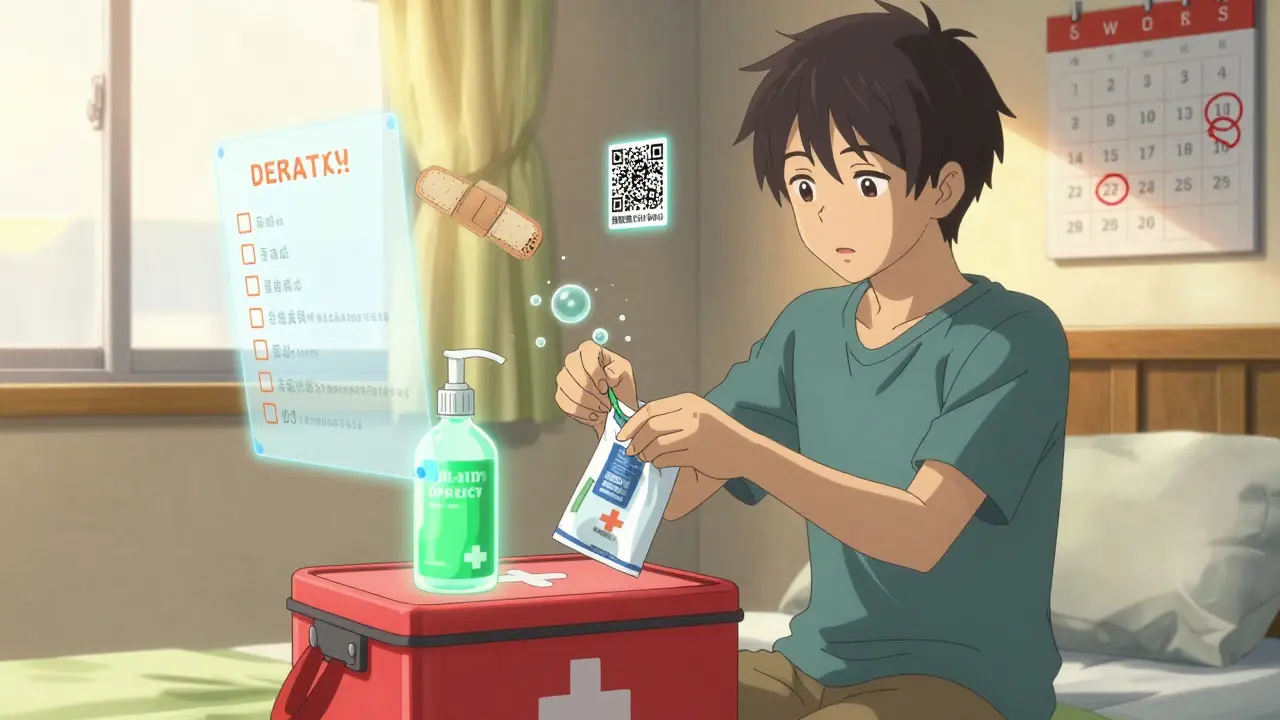
Setting a reminder on your phone isn’t enough. You need a system. The American Red Cross recommends a simple four-step routine:
- Quarterly visual check: Look at everything. Is anything discolored? Smelly? Leaking? Toss it.
- Biannual date check: Every 6 months, pull out every item and write the expiration date on a sticky note. Put it on the outside of the kit.
- Replace emergency meds early: If your EpiPen expires in 60 days, replace it now. Don’t wait until the last minute.
- Annual full overhaul: Once a year, empty the whole kit. Clean it out. Restock with new items. Throw away the old.
Pro tip: When you buy a new first-aid kit, check the expiration dates on the items inside. A 2023 Consumer Reports survey found 38% of store-bought kits had items expiring within 6 months of purchase. You’re paying for safety-you shouldn’t get a kit that’s already half-dead.
What to Do If You’re Forced to Use an Expired Medication
Sometimes, you have no choice. Maybe you’re in a remote area. Maybe it’s an emergency and you’re out of options. The FDA and Cleveland Clinic both say: if you have no alternative, use it.
But with conditions:
- For epinephrine or albuterol: Use the expired dose, then immediately call 911 or go to the ER. You may need a second dose.
- For pain relievers: If it looks and smells fine, take it-but don’t expect full relief. If it doesn’t help, don’t take more. Get proper care.
- Never use expired antibiotics, eye drops, or creams. The risk of infection is too high.
Remember: a weak dose isn’t harmless. It can lead to incomplete treatment, worsening infections, or antibiotic resistance. That’s why the Institute for Safe Medication Practices has documented over 120 cases of skin infections linked to expired topical antibiotics.
The Bigger Picture
More than 68% of households have at least one expired medication in their first-aid kit, according to a 2023 American Red Cross survey. And 71% of people think OTC meds stay effective for 2+ years past expiration. That’s dangerously wrong.
Manufacturers are starting to respond. New smart kits now use Bluetooth to remind you when items expire. Some bottles have QR codes that scan to show real-time potency estimates. Others have color-changing labels that turn red if the medication got too hot.
But until those are everywhere, the responsibility is yours. Your first-aid kit isn’t a decoration. It’s your backup in a crisis. If it’s expired, it’s not just outdated-it’s unreliable. And in an emergency, reliability is everything.
Can I still use expired ibuprofen or acetaminophen?
Yes, if it’s been only a few months past expiration and stored properly in a cool, dry place. Solid tablets like ibuprofen and acetaminophen often retain 90% of their potency for years. But check for cracks, odd smells, or discoloration. If anything looks off, toss it. Never use expired pills if they’re crumbling or smell like vinegar.
Why do some medications expire so quickly?
Liquid medications, creams, and injections are more sensitive to air, heat, and moisture. Epinephrine, eye drops, and antibiotics break down chemically over time. Even if the bottle says "use by 2025," once opened, exposure to air starts degrading them. That’s why nitroglycerine tablets last only 3-6 months after opening, and why hydrogen peroxide only works for 30 days after you open it.
Is it dangerous to use expired medications?
Most expired medications don’t become toxic. The real danger is losing potency. An expired antibiotic might not kill all the bacteria, leading to a stronger infection. An expired EpiPen might not stop a severe allergic reaction. And expired eye drops can cause serious eye infections. In rare cases, degraded creams or liquids can grow harmful bacteria.
How should I dispose of expired medications?
Don’t flush them or throw them in the trash. Use a drug take-back program. The DEA’s National Prescription Drug Take Back Day collects expired meds safely across the U.S. Many pharmacies and local health departments also offer drop-off bins. If no program is available, mix pills with coffee grounds or cat litter in a sealed bag before tossing them-this prevents misuse and reduces environmental harm.
Should I replace my first-aid kit every year?
Yes, for peace of mind. Even if most items are still good, annual replacement ensures you’re never caught off guard. Emergency items like epinephrine and nitroglycerine should be replaced 30 days before they expire. Bandages, gauze, and antiseptics degrade over time too-stickiness fades, sterility fades. A full yearly check keeps your kit reliable when you need it most.
Michaela Jorstad
February 20, 2026 AT 20:37I love how this post breaks it down so clearly-seriously, I used to just toss everything into a drawer and hope for the best. Now? I have a little notebook next to my first-aid kit, and every quarter, I write down what’s expired, what’s still good, and what needs replacing. It’s such a tiny habit, but it’s saved me twice already-once when my kid had a severe bug bite, and again when my husband got a deep cut during a camping trip. Don’t underestimate the power of a little consistency.
Chris Beeley
February 21, 2026 AT 14:25Let me be blunt: this entire post is a masterclass in practical rationality, and yet, it still doesn’t go far enough. You mention the FDA, you cite studies, you even reference Johns Hopkins-but where is the philosophical grounding? The real issue isn’t expiration dates-it’s our cultural addiction to passive safety. We outsource survival to manufacturers, to labels, to corporate assurances, as if medicine were a product and not a lifeline. In pre-industrial societies, people didn’t have expiration dates-they had intuition, observation, and ritual. We’ve replaced wisdom with barcodes. And now, when the system fails-because it always does-we’re left with a half-dead EpiPen and a moral panic. This isn’t about storage. It’s about epistemology.
Arshdeep Singh
February 22, 2026 AT 19:06Danielle Gerrish
February 23, 2026 AT 06:39Okay, I’m going to be honest-I’ve been ignoring my first-aid kit for three years. Three years. I thought, ‘It’s just aspirin, it’ll be fine.’ Then last month, my niece had a bee sting and I grabbed the EpiPen… and it was so old the plunger didn’t even click right. I had to use two of them. Two. And then I cried. Not because I was scared-I was furious. Furious that I didn’t check. Furious that no one ever taught me how. This post? It’s the wake-up call I didn’t know I needed. I just threw out everything. Bought a new kit. Put a reminder on my phone. And now I’m checking it every month. No more excuses.
Maddi Barnes
February 24, 2026 AT 06:28OMG YES. 🙌 I used to think expired meds were ‘probably fine’-until I saw my mom’s old hydrocortisone cream turn into a moldy science experiment. I swear, I opened it and there was a tiny green fuzzy cloud inside. 🤢 I now label EVERYTHING with the opening date, not just the expiration. And I keep my kit in the bedroom drawer like a sacred relic. Also-why is it that pharmacies sell kits with items expiring in 6 months? That’s a scam. We’re paying for ‘new’ when it’s already half-dead. 😒
Benjamin Fox
February 24, 2026 AT 16:30Jonathan Rutter
February 25, 2026 AT 19:56You know what’s worse than expired meds? People who treat them like a checklist. ‘Oh, I checked the expiration date.’ Big deal. Did you check the humidity? The light exposure? The air quality? Did you consider that your kid’s EpiPen was stored in a gym bag for six months while you were traveling? No. You didn’t. You just looked at a label. And now you’re patting yourself on the back. That’s not responsibility-that’s performance. Real safety isn’t about ticking boxes. It’s about vigilance. It’s about knowing that a single pill, a single drop, a single breath of moisture can turn a lifesaver into a liability. And you? You’re still asleep.
Jana Eiffel
February 27, 2026 AT 15:02It is a matter of profound ethical and epistemological significance that we have come to treat pharmacological integrity as a matter of commercial convenience rather than existential necessity. The commodification of health-reduced to expiration dates printed by corporate entities with profit motives-represents a fundamental alienation from the bodily autonomy once held sacred in pre-modern healing traditions. One cannot rely upon a label when the body itself is the final arbiter of efficacy. The true imperative lies not in replacement, but in cultivation of discernment: the ability to observe, to sense, to understand the subtle signs of degradation not as a checklist, but as a dialogue with one’s own physiology.
aine power
February 28, 2026 AT 09:49