


Imagine this: you have five different pills to take each day. Some in the morning, some at night, some with food, some on an empty stomach. You mean to take them. You even set alarms. But by Wednesday, one pill is still sitting in its bottle. By Friday, you’re not sure if you took the afternoon dose. Sound familiar? You’re not alone. About half of all people with chronic conditions don’t take their meds as prescribed. And it’s not because they’re forgetful or careless - it’s because the system doesn’t match their life.
Why Your Routine Isn’t Working
Most medication routines fail because they’re built around the drug, not the person. Doctors give you a list. Pharmacists hand you a bottle. You’re left to figure out how to squeeze it into your day. But your day already has structure. You brush your teeth. You eat breakfast. You feed the dog. You check your phone before bed. Those are anchors. Your meds should latch onto them, not fight against them.A 2022 Stanford Medicine study found that 78% of people improved adherence when they paired their pills with a daily habit. Not an alarm. Not a sticky note. A real, repeated behavior. Brushing your teeth in the morning? That’s your cue for your blood pressure pill. Eating dinner? That’s when you take your cholesterol med. Your body learns the pattern. Your brain stops having to think about it.
Start With One Anchor
Don’t try to rebuild your whole routine overnight. Pick one medication - the one you miss most often - and tie it to one existing habit. If you always have coffee right after waking up, take that pill with your first sip. If you always sit down to check your messages before bed, take your nighttime pill right after. Do this for a week. No exceptions. Just one pill, one habit.Why one? Because success builds momentum. When you nail that one, you’ll feel capable. You’ll start thinking, “I can do this.” Then you add another. And another. Slow wins. Consistency beats perfection.
The Pill Organizer That Actually Works
A basic pill bottle doesn’t cut it anymore. If you’re taking meds at different times of day, you need a system that shows you what’s been taken and what’s left. A weekly pill organizer with separate compartments for morning, afternoon, evening, and night is the most reliable tool out there. It’s low-tech, cheap, and works even if your phone dies.Here’s how to make it stick: Fill it every Friday night. Why Friday? Because it’s the end of the workweek for most people. You’re home. You’re not rushing. You have time to check labels, sort pills, and even double-check with your doctor’s list. A 2021 American Heart Association report found that 68% of patients who filled their organizers on Friday nights stuck with the habit for over a year.
Pro tip: Use colored labels. Blue for morning, red for afternoon, yellow for night. If you have trouble reading small print, this simple trick cuts dosing errors by 28%, according to the same study. And if you’re traveling? Take your organizer. Don’t rely on your hotel minibar or a ziplock bag. Keep it in your purse, your carry-on, or even your shoebox if you have to.

Technology Is a Tool - Not a Fix
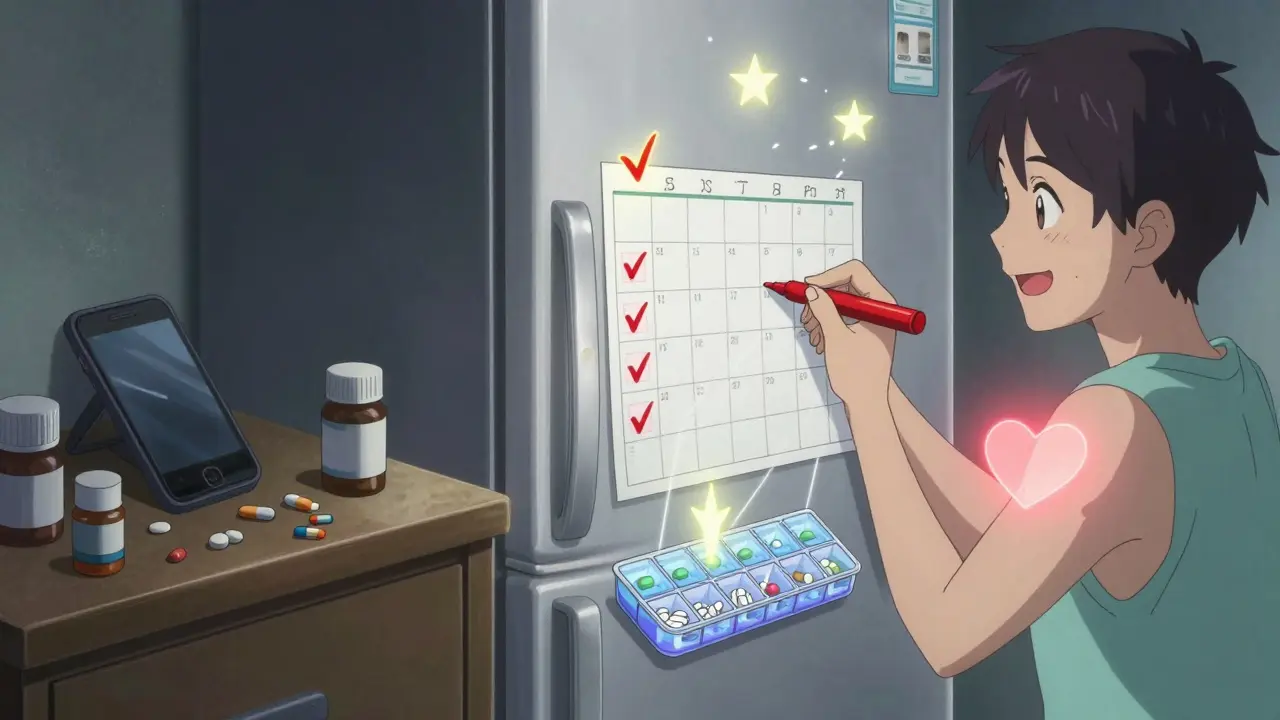
Smartphones are great. But they’re not magic. A 2020 MedStar Health study showed that 63% of people aged 50-75 improved adherence with phone alarms. But for those over 75? That number dropped to 45%. Why? Phones get silenced. Batteries die. Notifications get buried. And if you’re not tech-savvy, setting up an alarm feels like a chore.Instead, use tech as backup. Set a daily alarm, yes - but also use a visual tracker. Get a calendar. Put it on your fridge. Every time you take a pill, mark it with a big X. A 2011 study in the PMC journal found that people who checked off doses reduced missed pills by 32%. It’s satisfying. It’s visible. It’s hard to ignore.
For those who still want tech, consider a timer cap. These are caps that screw onto your pill bottle and beep when it’s time to take the dose. No phone needed. No app to download. Just a gentle reminder that doesn’t disappear into a notification pile. ProMedica’s 2023 data shows these maintain 62% effectiveness across all age groups - higher than smartphone alarms for seniors.
When Your Meds Don’t Fit Your Life
Sometimes the problem isn’t the routine - it’s the regimen. Taking four pills three times a day is exhausting. It’s no wonder people skip doses. The good news? You don’t have to accept that.Dr. Robert L. Page II, a medication specialist, says the most effective routine is the one with the fewest pills. If you’re on multiple meds, ask your doctor: “Can any of these be combined? Can we switch to once-daily versions?” Studies show that reducing daily doses by even one or two cuts non-adherence by 40%. A 2022 Johns Hopkins study found that patients who helped design their own dosing schedule had 37% better adherence than those given a preset plan.
Also, check if any meds can be taken with food. Some need an empty stomach. Others work better with a meal. If yours can be taken with breakfast, make breakfast your pill time. No extra effort needed.
What to Do When Things Go Wrong
Life happens. You go on vacation. You get sick. You change shifts. Your routine breaks. That’s normal. Don’t panic. Don’t guilt-trip yourself. Just reset.Here’s a simple rule: If you miss a dose, don’t double up unless your doctor says so. Instead, take it as soon as you remember - unless it’s close to the next dose. Then skip it. Go back to your schedule. Missing one dose doesn’t ruin everything. Missing three because you felt guilty? That’s the real problem.
Traveling? Pack extra pills. Put them in your organizer. Bring a small ziplock with a copy of your med list. If you’re flying, keep meds in your carry-on - not checked luggage. And if you’re staying somewhere long-term? Ask your pharmacist about mail-order refills. No more running out.
Common Pitfalls (And How to Avoid Them)
- Too many meds at once - This is the #1 reason people skip doses. Talk to your doctor about simplifying. Ask about combination pills.
- Side effects - If a pill makes you dizzy, nauseous, or tired, don’t stop it. Tell your doctor. There might be a better option.
- Confusing labels - If your pill bottle says “take as needed,” but your doctor said “take daily,” call your pharmacy. Clarify it. Write it down.
- Over-relying on memory - Your brain is not a pill tracker. Use a calendar, organizer, or alarm. Even if you think you’ll remember, you won’t.
- Ignoring refill dates - Set a calendar alert for refills 3 days before you run out. Don’t wait until you’re out.
What Works Best - The Real Numbers
Here’s what the data says about real-world effectiveness:| Strategy | Effectiveness | Best For |
|---|---|---|
| Pill organizer (weekly, AM/PM/night) | 35% improvement | People on 3+ meds |
| Pairing with toothbrushing | 72% adherence | Morning/evening doses |
| Pairing with meals | 68% adherence | Meds that can be taken with food |
| Medication calendar (checkmarks) | 32% reduction in missed doses | Visual learners |
| Timer cap on bottle | 62% effectiveness | All ages, especially seniors |
| Smartphone alarms | 75% under 65; 45% over 75 | Younger, tech-savvy users |
| Medication journal (logging each dose) | 78% adherence | Patients with strong memory |
Notice something? The highest success rate isn’t from a fancy app. It’s from a simple checklist and a consistent habit. The tools matter - but the routine matters more.
Final Thought: Make It Part of You
Your medication isn’t a chore. It’s part of your health. And like brushing your teeth or drinking water, it should feel natural. Not forced. Not stressful. Just… done.Start small. Tie one pill to one habit. Use a pill organizer. Fill it Friday night. Mark your calendar. Ask your doctor if you can simplify. And if you miss a day? Don’t quit. Just start again tomorrow.
Because sticking to your meds isn’t about willpower. It’s about design. And with the right system, you don’t have to be perfect. You just have to be consistent.
What if I forget to take my pill?
If you miss a dose, don’t double up unless your doctor says to. Take it as soon as you remember - unless it’s almost time for the next dose. Then skip it and go back to your regular schedule. Missing one dose won’t ruin your progress. Worrying about it and then skipping the next one will.
Can I use a pill organizer for all my medications?
Most can, but not all. Some pills shouldn’t be removed from their original packaging - like nitroglycerin, certain antibiotics, or pills that are sensitive to light or moisture. Always check with your pharmacist. For those, keep them in their original bottles and use the organizer only for the ones that are safe to move.
Is it okay to take my meds with food if the label doesn’t say so?
No - not without checking. Some medications need an empty stomach to work properly. Others can cause nausea if taken without food. Always confirm with your doctor or pharmacist. If you’re unsure, call them before you take it. It’s safer than guessing.
Why do I keep missing doses even though I know I need them?
Often, it’s not about forgetting - it’s about feeling overwhelmed. Taking five pills three times a day is mentally exhausting. Talk to your doctor about simplifying your regimen. Maybe some meds can be combined, switched to once-daily, or even stopped. Also, check if side effects are making you want to skip them. If so, tell your doctor - there might be a better option.
Are smartphone reminders reliable for older adults?
For many, no. Studies show smartphone alarms work well for people under 65, but effectiveness drops sharply after 75. That’s often due to difficulty setting them, forgetting to charge the phone, or accidentally silencing alerts. For older adults, a simple timer cap on the pill bottle or a visual calendar often works better. Tech should support - not replace - easy, physical systems.
Prateek Nalwaya
February 17, 2026 AT 00:27Love this. I’ve been taking my blood pressure pill with my morning coffee for six months now-no misses. It’s wild how your brain just… absorbs the habit. No alarms, no apps, just that first sip and the pill goes down like it’s always belonged there. I didn’t even realize I’d stopped thinking about it until I missed a day and felt like I forgot my keys.
Linda Franchock
February 17, 2026 AT 04:37Wow. Finally someone who gets it. Not ‘set an alarm’ but ‘tie it to brushing your teeth.’ Like, wow. I’ve been on five meds since 2020 and my phone’s alarm just makes me rage-quit my entire morning. Now I take my cholesterol pill right after I floss. It’s weirdly satisfying. Like a ritual. I even started humming. Don’t judge.
Digital Raju Yadav
February 18, 2026 AT 13:34This is why India’s healthcare system is failing. People don’t need ‘anchors’-they need discipline. You want to live? Take the damn pill. No excuses. My uncle had diabetes and took his insulin like clockwork because he didn’t have time for your ‘coffee ritual.’ He worked two jobs and still lived to 82. Stop coddling people.
Liam Earney
February 19, 2026 AT 11:06Oh my god, I’m so glad someone finally said this-because I’ve been trying to explain this to my sister for two years now, and she just keeps saying ‘I’ll set a reminder’-and then she doesn’t, and then she feels guilty, and then she skips three days, and then she’s back to square one-so I just… I don’t know-this article is like a warm hug from a therapist who actually listened, and I’m crying a little because I’ve been trying to get people to understand that it’s not about willpower, it’s about architecture-like, the structure of your day, the rhythm of your life, the way your body moves through time-and if your meds don’t fit into that, they’re just… noise.
Sam Pearlman
February 20, 2026 AT 11:01Wait wait wait-so you’re telling me the answer to medication adherence is… *not* using technology? What’s next? You’re gonna tell me to use a paper map instead of Google Maps? I mean, I get it, but… are we regressing? Is this a Luddite movement disguised as healthcare advice? Just asking.
Steph Carr
February 20, 2026 AT 15:56Let’s be real-half the reason people skip meds isn’t forgetfulness. It’s the cost. Or the side effects. Or the fact that their doctor won’t listen when they say ‘this makes me feel like a zombie.’ But instead of fixing those, we tell people to ‘pair it with toothbrushing.’ Cute. Meanwhile, the system is still asking people to pay $300 for a pill that should cost $12. So yeah, nice tips. But let’s fix the damn system too.
Brenda K. Wolfgram Moore
February 21, 2026 AT 20:03Simple. Effective. I’ve been using a pill organizer since last year. Filled every Friday. Blue for morning, red for night. No alarms. No apps. Just me, my coffee, and the little plastic grid. I’ve missed one dose in 14 months. And I’m 68. If I can do it, anyone can. Stop overcomplicating it.
Carrie Schluckbier
February 22, 2026 AT 14:59Did you know the government is secretly using pill organizers to track your medication intake? That’s why they push ‘Friday night filling’-it’s a data harvest. They’re building a health surveillance database under the guise of ‘adherence.’ Next thing you know, your insurance will deny coverage if you miss a dose. I checked the FDA’s 2023 funding report-14 million went to ‘behavioral compliance tech.’ Coincidence? I think not.
Oliver Calvert
February 23, 2026 AT 08:54Pairing meds with habits works. I’ve seen it in clinics. The key is consistency not complexity. One anchor. One habit. One pill. Start there. Don’t try to fix everything at once. That’s how people fail. Simple beats perfect every time.
Kancharla Pavan
February 25, 2026 AT 01:41Why are we still talking about ‘anchors’ and ‘rituals’? This is not a self-help blog. This is medicine. You have a condition. You have a prescription. You take it. Period. If you can’t manage five pills a day, maybe you shouldn’t be managing your own health. There’s a reason we have caregivers. There’s a reason we have pharmacies. Stop romanticizing forgetfulness. This isn’t mindfulness-it’s medical negligence dressed up as a productivity hack.
Dennis Santarinala
February 25, 2026 AT 06:07I used to hate taking my meds. Felt like a chore. Then I started doing it right after I turned off my bedside lamp at night. Just… one motion. No thinking. Now I do it without even realizing. It’s like my body just… knows. I didn’t change my life-I just changed the timing. And it stuck. So yeah. One habit. One pill. It works.
Logan Hawker
February 26, 2026 AT 05:33It’s fascinating how this article anthropomorphizes adherence as if it’s a lifestyle brand. ‘Anchor habits.’ ‘Visual trackers.’ ‘Color-coded compartments.’ It reads like a wellness influencer’s TED Talk. But let’s be honest-this is just behavioral economics repackaged as empathy. The real issue? Pharmaceutical capitalism. The real solution? Single-pill combinations and universal access. Not a better pill organizer.
James Lloyd
February 27, 2026 AT 03:05Excellent breakdown. The data is clear: habit-stacking outperforms digital reminders across age groups. The 78% adherence rate with toothbrushing is particularly compelling. For patients with cognitive load issues-especially those with comorbid depression or dementia-this approach reduces executive demand. It’s not magic. It’s neurocognitive efficiency. And yes, Friday night filling is genius. It leverages the end-of-week cognitive reset. Smart.
Haley DeWitt
February 27, 2026 AT 03:37OMG YES. I’ve been using the color-coded organizer since January and I’ve only missed once! I even got my mom to do it too. She’s 71 and says it’s the first time she’s felt in control. I put little stickers on the days I take it-like a reward system 😊
John Haberstroh
March 1, 2026 AT 01:35My dad’s on eight meds. We tried alarms. We tried apps. We tried sticky notes. Then we started putting his pills in his favorite coffee mug every morning. He drinks it at 7:15 a.m. sharp. No exceptions. Now he takes everything on time. We didn’t change the meds. We changed the context. Sometimes the fix isn’t in the bottle-it’s in the cup.