


Kidney Function Calculator for Creatine Users
How Creatine Affects Your Tests
Creatine can increase your serum creatinine levels by 10-30%, which may falsely lower your eGFR (estimated glomerular filtration rate) into kidney disease range.
When you take creatine to build strength or recover faster from workouts, you’re not just adding a supplement-you’re changing how your body looks to kidney tests. That’s a problem if you have kidney disease or take medications like ACE inhibitors, NSAIDs, or diuretics. The issue isn’t that creatine harms your kidneys-it’s that it tricks the tests doctors use to check them.
Why Creatine Messes With Kidney Test Results
Creatine breaks down into creatinine, a waste product your kidneys filter out. That’s why doctors use serum creatinine to estimate how well your kidneys are working-through a number called eGFR. But when you take creatine, your body makes more creatinine than normal. That doesn’t mean your kidneys are failing. It just means the test is reading false signals. Studies show that taking 3-5 grams of creatine daily raises serum creatinine by 10-30%. That’s enough to push someone’s eGFR from a healthy 90 down to 75-right into the range labeled as early-stage kidney disease. In reality, their kidneys are working fine. This isn’t theoretical. People on Reddit and fitness forums have been misdiagnosed with CKD just because they were taking creatine. One user’s eGFR jumped from 95 to 78 after starting creatine. After stopping, it went back to normal.What Happens When Creatine Meets Kidney Medications
If you’re on medication for kidney disease, you’re already at higher risk for complications. Drugs like ACE inhibitors and ARBs help protect your kidneys by lowering blood pressure and reducing protein in the urine. But they also affect how creatinine is handled by the kidneys. Add creatine into the mix, and the test results become even harder to interpret. The real danger isn’t creatine itself. It’s that your doctor might think your kidneys are getting worse when they’re not. That could lead to unnecessary changes in your meds, extra scans, or even referrals to specialists you don’t need. A 2023 study in the Journal of Clinical Nephrology found only 42% of primary care doctors ask patients if they take creatine when they see high creatinine. That’s a gap that puts people at risk.What the Science Really Says About Safety
Multiple long-term studies-some lasting over a year-show creatine doesn’t damage kidneys in healthy people. A 2024 Mendelian randomization study analyzed genetic data from over 500,000 people and found no link between creatine levels and kidney function. The beta value was -0.003, with a p-value of 0.87. That means there’s no causal relationship. The American College of Sports Medicine, UCLA Health, and the National Kidney Foundation all agree: creatine is safe for healthy adults. But there’s one big exception: people with existing kidney disease. Case reports are rare, but they exist. One 2011 report described a man with no prior kidney issues who developed acute tubular necrosis after taking 3 grams of creatine daily. He wasn’t on any nephrotoxic drugs. That’s an outlier, but it’s why experts say: if you have kidney disease, don’t take creatine unless your nephrologist says it’s okay.
How to Monitor Your Kidneys Correctly If You Take Creatine
The key is to stop relying on serum creatinine alone. Here’s what actually works:- Test cystatin C instead. Unlike creatinine, cystatin C isn’t affected by creatine supplements. It’s a more accurate marker of kidney function. The CKD-EPI equation using cystatin C gives results that match true GFR within 95% accuracy in creatine users.
- Use 24-hour urine creatinine clearance. This measures how much creatinine your body actually clears over a full day. If your kidneys are healthy, your urine creatinine output stays steady-even if your blood creatinine rises.
- Get a baseline before starting. If you plan to take creatine, get your creatinine and cystatin C tested first. That way, any future changes can be compared to your personal baseline, not a generic normal range.
- Tell every doctor you see. Write it on your medication list. Say it out loud at every appointment. Most providers don’t think to ask.
What to Do If You’re Already on Kidney Medications
If you’re taking medication for kidney disease, the safest path is to avoid creatine unless your nephrologist approves it. Even if your kidney function seems stable, adding creatine adds noise to your monitoring. That noise can lead to mistakes-like increasing your ACE inhibitor dose when you don’t need to, or delaying a needed treatment because your labs look worse than they are. Some people argue that creatine might help protect kidneys by improving muscle mass and reducing inflammation. But that’s still experimental. No guidelines recommend it for people with kidney disease. Until more data comes in, caution wins.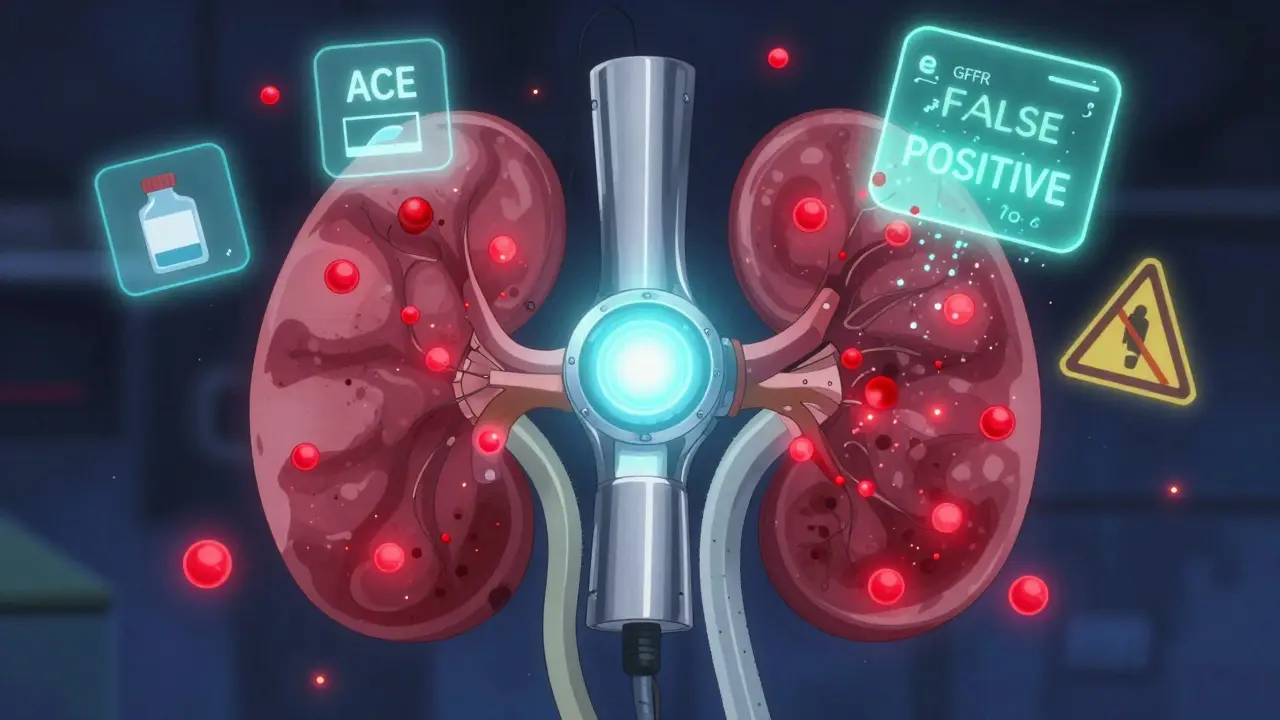
What’s Coming Next in Kidney Monitoring
Researchers are working on fixes. The University of Toronto presented data at ASN Kidney Week 2023 showing that applying a 0.9 multiplier to creatinine levels in creatine users improves eGFR accuracy. This could become part of future lab reports-automatically adjusting for supplement use. The National Kidney Foundation is expected to release updated guidelines in late 2024. These will likely include specific advice for creatine users, especially those on kidney medications. Right now, only 38% of nephrologists have formal protocols for this. That’s changing.Bottom Line: Creatine Is Safe-If You Know How to Read the Results
Creatine isn’t the enemy. Misunderstanding the tests is. If you’re healthy and taking creatine, your kidneys are probably fine. But your blood test might say otherwise. That’s why you need to know which tests to trust. Cystatin C is your friend. Serum creatinine is not. If you have kidney disease or take medications that affect kidney function, talk to your nephrologist before starting creatine. Don’t assume it’s safe just because it’s popular. And if you’ve ever been told you have early kidney disease but feel fine-ask if you’re taking creatine. You might be one test away from a false diagnosis.Bottom line: Creatine won’t break your kidneys. But it can break your lab results. Know the difference.
Shanna Sung
January 3, 2026 AT 22:08They’re hiding the truth. Creatine is a CIA bioweapon disguised as a gym supplement. They want us to think it’s safe so we keep taking it and our kidneys slowly turn to sludge while the pharmaceutical giants profit off the ‘misdiagnoses’.
They’ve been doing this since the 90s. Look up the 1998 FDA memo they buried. I’ve got screenshots.
Allen Ye
January 5, 2026 AT 18:12There’s a deeper philosophical question here: if a biomarker lies in a lab report and no one asks whether the patient takes creatine, does it still represent disease? We’ve outsourced our bodily intuition to algorithms and blood tubes, and now we’re terrified of our own physiology.
Our bodies aren’t broken when creatinine rises-they’re just speaking a language the medical-industrial complex refuses to learn. The real tragedy isn’t creatine-it’s our collective surrender to reductionist diagnostics. We’ve forgotten that health isn’t a number. It’s rhythm. It’s resilience. It’s the quiet hum of a body that knows how to heal, even when the machines say otherwise.
John Ross
January 7, 2026 AT 00:08Let’s cut through the noise: creatine-induced hypercreatininemia is a well-documented confounder in eGFR estimation. The 10–30% elevation is statistically significant and clinically relevant. The real issue is cognitive bias-clinicians defaulting to CKD without ruling out supplement use.
Per KDIGO 2023, creatinine-based eGFR is not recommended in athletes or supplement users. Cystatin C is the gold standard here. If your lab doesn’t offer it, demand it. Or switch labs. Your nephrologist should be running both markers routinely if you’re on ACEi/ARBs. This isn’t opinion-it’s guideline-driven practice.
Clint Moser
January 7, 2026 AT 20:24creatine is a scam by big pharma to make you buy more kidney meds. i read on a forum that the guy who invented it worked for a drug company and they paid him to hide the truth. i saw a video where a guy’s creatinine went from 0.9 to 1.8 in 2 weeks and they said he had stage 3 ckd but he was just taking creatine. they dont tell you this because they make billions off dialysis. the government knows but they let it happen because of the prison-industrial complex. my cousin’s dog got kidney failure after eating a creatine bar. its all connected.
Ashley Viñas
January 9, 2026 AT 08:12Oh honey. You took creatine? And you didn’t tell your doctor? Sweetie, this isn’t the 2000s. You’re not a college kid lifting weights in your dorm anymore. You’re an adult with kidneys that have to last you until you’re 80.
It’s not about being ‘judgmental’-it’s about being responsible. If you’re on meds, you’re not ‘just a gym bro.’ You’re a patient. And patients who don’t disclose supplements? They’re the ones who end up in the ER with AKI. I’m not mad-I’m just disappointed. You had the information. You chose to ignore it.
Mandy Kowitz
January 10, 2026 AT 02:24Wow. So the solution is to stop taking creatine… or just lie to your doctor? Genius. I’m sure they’ll appreciate the honesty when you say ‘oh yeah, I’ve been taking this yellow powder since 2020’ during your 12-minute appointment.
Also, cystatin C? That’s like $120 extra. Thanks for the advice, rich person.
Justin Lowans
January 11, 2026 AT 04:11This is one of the most thoughtful, clinically grounded pieces I’ve read in months. The distinction between biochemical artifact and true pathology is not just academic-it’s life-altering. Thank you for emphasizing cystatin C and baseline testing. Too many patients are left in limbo because clinicians treat labs like gospel, not signals.
I’ve seen patients mislabeled with CKD, then prescribed restrictive diets and unnecessary meds-all because no one asked about creatine. This should be required reading for all primary care residents.
Michael Rudge
January 12, 2026 AT 16:32Let’s be real: if you’re taking creatine and you have kidney disease, you’re either delusional or actively self-sabotaging. You’re not ‘being proactive’-you’re playing Russian roulette with your nephrons.
And for the love of God, if you’re on ACE inhibitors and think creatine is ‘safe because it’s natural,’ you’re the reason people die waiting for transplants. Stop pretending supplements are harmless just because they’re sold in a gym. They’re pharmaceutical-grade compounds with pharmacokinetics. Read the damn label.
Doreen Pachificus
January 14, 2026 AT 10:42So… if I take creatine and my creatinine goes up, but my cystatin C is normal, does that mean I’m fine? Or should I still be worried? I’ve been taking 5g/day for 3 years and my doctor just said ‘your numbers look fine’ without asking about supplements. Should I be asking for a cystatin C test? Or am I overthinking it?
Akshaya Gandra _ Student - EastCaryMS
January 14, 2026 AT 14:40im from india and we dont have cystatin c test in most places here. creatine is cheap and popular here too. what should we do? my uncle is on dialysis and he takes creatine because he thinks it helps his muscles. he says his doctor said its ok. is he right? i am scared.
en Max
January 15, 2026 AT 02:58As a board-certified nephrologist with over 22 years of clinical experience, I must emphasize: creatine supplementation in patients with chronic kidney disease (CKD) remains contraindicated in the absence of prospective, randomized, controlled trials demonstrating long-term safety. While the evidence in healthy populations is reassuring, the pathophysiological interplay between creatine metabolism, tubular reabsorption, and drug-induced hemodynamic alterations in CKD is not fully elucidated.
Therefore, the standard of care remains caution. Baseline cystatin C, 24-hour urine creatinine clearance, and serial monitoring are non-negotiable. Patient education must be documented. And yes-this requires time. Unfortunately, time is the one resource we are systematically deprived of in modern healthcare.
Angie Rehe
January 15, 2026 AT 18:29Oh, so now we’re supposed to get a cystatin C test just because someone took a protein powder? That’s a $150 blood test. My insurance won’t cover it unless I have ‘evidence of kidney disease.’
Meanwhile, my doctor still thinks ‘normal creatinine’ means ‘normal kidneys.’
And you’re telling me I need to go to a specialist to explain that I take creatine? I’m not a scientist. I’m a single mom who works two jobs. This system is rigged.
Jacob Milano
January 16, 2026 AT 12:39I’ve been on ACE inhibitors for 8 years and started creatine last year. My eGFR dropped from 88 to 76. I panicked, stopped creatine, and got a cystatin C test three weeks later-it was perfect. My eGFR went back to 87.
So yeah, it’s not magic. It’s math. And your doctor might not know the formula. But you can. Tell them. Show them this post. Don’t wait for them to ask. You’re your own best advocate.
And hey-if you’re feeling stronger, sleeping better, and your legs don’t feel like lead? Your kidneys might be fine. The numbers just don’t know it yet.
Peyton Feuer
January 17, 2026 AT 09:15Thanks for this. I’ve been taking creatine for 5 years and have mild hypertension on lisinopril. I never told my PCP because I didn’t want to be judged. Now I’m gonna bring this up at my next appointment. Just… thanks for saying it out loud.