


Anticoagulant Reversal Agent Selector
Select Anticoagulant
Reversal Agent Recommendation
Recommended Reversal Agent
Time to Effect:
Thrombosis Risk:
Cost:
Availability:
Alternative Approach
Important Warning
Key Takeaways
- Warfarin 4F-PCC + Vitamin K
- Dabigatran Idarucizumab
- Rivaroxaban/Apixaban Andexanet Alfa
- If primary agent unavailable Use 4F-PCC
When someone on blood thinners suffers a serious bleed-like a fall that causes a brain hemorrhage-time isn’t just money. It’s life. And in those critical minutes, doctors don’t just hope for the best. They reach for specific reversal agents designed to stop the bleeding fast. But not all reversal agents are the same. Some work in minutes. Others take hours. Some cost thousands. Others are cheap and widely available. Understanding which one to use, when, and why can mean the difference between survival and tragedy.
Why Do We Need Reversal Agents?
About 4 million Americans take blood thinners every year. Most of them are on warfarin, dabigatran, rivaroxaban, or apixaban. These drugs prevent strokes and clots, but they also make bleeding more dangerous. When a major bleed happens-especially in the brain-about 30% to 50% of patients die. That’s why reversal agents exist: to quickly undo the anticoagulant effect and give the body a chance to stop the bleeding. The goal isn’t just to fix the clotting problem. It’s to stop the bleed from getting worse. Every minute counts. A brain hemorrhage that expands by even 1 millimeter can double the risk of death. That’s why speed, accuracy, and knowing which agent to use matter more than ever.Vitamin K: The Old Workhorse
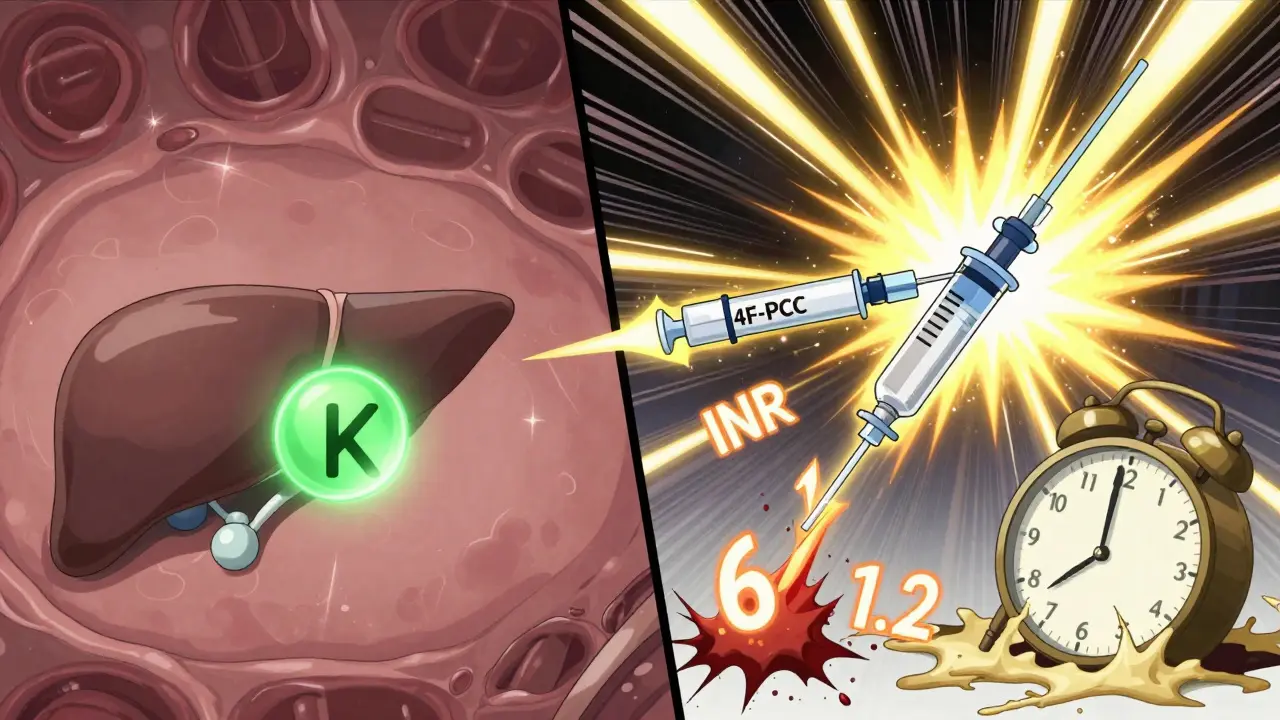
Vitamin K is the oldest reversal agent, used since the 1940s. It works only for warfarin and other vitamin K antagonists (VKAs). Warfarin blocks the liver from making clotting factors. Vitamin K flips that switch back on, letting the liver start producing those factors again. But here’s the catch: it takes hours. Even with a 5-10 mg IV dose, you won’t see much change for 4 to 6 hours. Full reversal can take up to 24 hours. That’s too slow for emergencies. So doctors never use vitamin K alone. They pair it with PCC. Why? Because PCC gives you instant clotting factors. Vitamin K just keeps the effect going. Without vitamin K after PCC, the body runs out of new factors, and the patient can start bleeding again. That’s called rebound anticoagulation. It’s rare, but deadly if missed.Prothrombin Complex Concentrate (PCC): The Go-To for Warfarin
Modern 4-factor PCC (4F-PCC) contains clotting factors II, VII, IX, and X, plus proteins C and S. It’s given as a single IV push and works in 15 to 30 minutes. It’s the standard for warfarin reversal because it’s fast, effective, and cheaper than the newer drugs. Dosing is based on INR levels:- INR 2-4: 25-35 units/kg
- INR 4-6: 35-50 units/kg
- INR >6: 50 units/kg
Idarucizumab: The Dabigatran Killer
Idarucizumab is a monoclonal antibody fragment. It binds to dabigatran like a magnet and pulls it out of the bloodstream. The effect? Almost instant. Within 5 minutes, 98% of patients show complete reversal of dabigatran’s anticoagulant effect. The dose is simple: two 2.5g IV infusions, totaling 5g. No weight-based math. No complex timing. Just two bags, given one after the other. It’s so straightforward that emergency rooms can train staff in under an hour. The RE-VERSE AD trial, published in the New England Journal of Medicine, showed that 82% of patients achieved hemostasis. Mortality was only 11%. Thrombotic events? Just 5%. That’s lower than PCC. It’s not perfect. It only works for dabigatran. If the patient is on rivaroxaban or apixaban, it does nothing. And it costs about $3,500 per dose. But for patients on Pradaxa, it’s the gold standard.Andexanet Alfa: The Powerful but Risky Option
Andexanet alfa is a modified version of factor Xa. It acts like a decoy, soaking up rivaroxaban, apixaban, and edoxaban so they can’t bind to the real factor Xa in the body. The result? Rapid reversal. The dosing is more complex. You give a 400mg IV bolus, then a 4mg/min infusion for 120 minutes. It works in 2 to 5 minutes. The ANNEXA-4 trial showed 75% of patients achieved good hemostasis. But here’s the problem: it’s expensive and risky. Each treatment costs $13,500. Only 65% of U.S. hospitals stock it. And in trials, 14% of patients had serious clots-heart attacks, strokes, pulmonary embolisms. That’s twice the rate of PCC and three times that of idarucizumab. The FDA even put a boxed warning on it: risk of thrombosis. That’s rare for reversal agents. It’s why many doctors hesitate. In a 2023 survey, 63% of ER physicians expressed concern about its safety profile.Comparing the Four: Speed, Cost, Safety
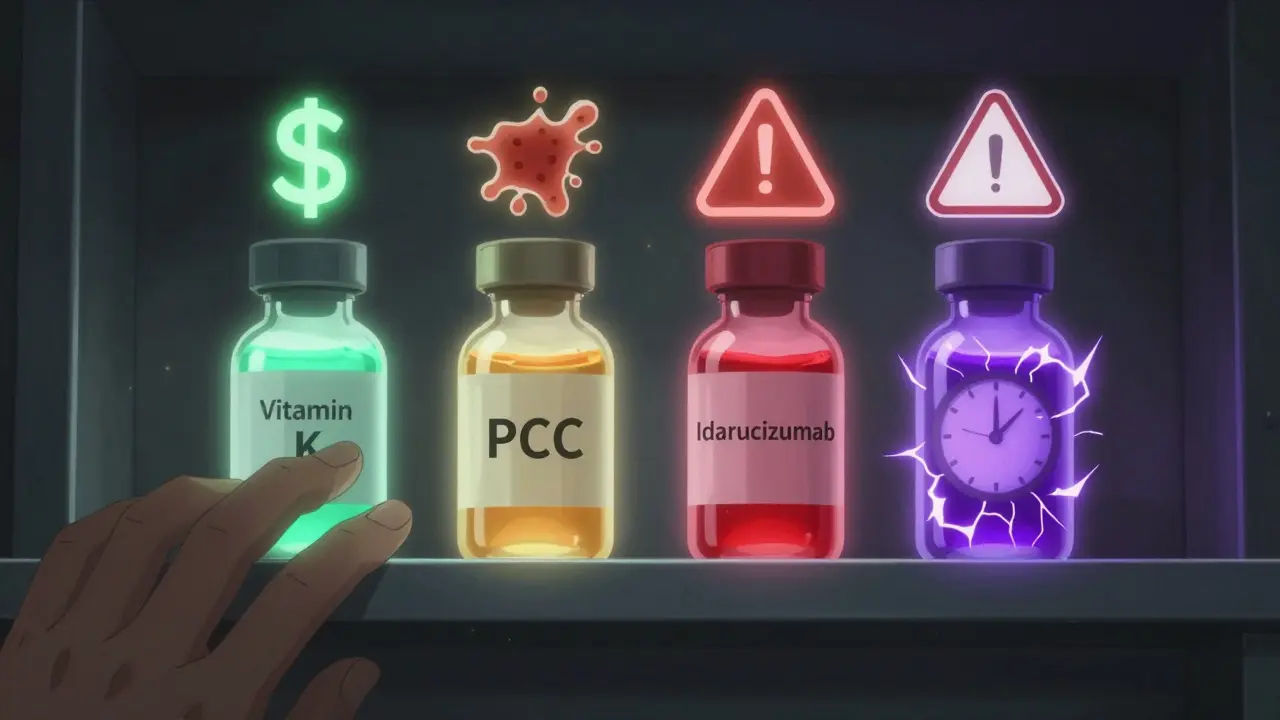
| Agent | Works For | Time to Effect | Dose | Cost (per treatment) | Thrombosis Risk | Hospital Availability |
|---|---|---|---|---|---|---|
| Vitamin K | Warfarin only | 4-24 hours | 5-10 mg IV | $5-$20 | Low | Universal |
| 4F-PCC | Warfarin, off-label for DOACs | 15-30 minutes | 25-50 units/kg | $1,200-$2,500 | 8% | Universal |
| Idarucizumab | Dabigatran only | 5 minutes | 5g IV (2 x 2.5g) | $3,500 | 5% | Most hospitals |
| Andexanet Alfa | Rivaroxaban, apixaban, edoxaban | 2-5 minutes | 400mg bolus + 4mg/min x 120 min | $13,500 | 14% | 65% of U.S. hospitals |
What Do Experts Really Think?
Dr. Joshua Goldstein, a leading hematologist, says: "The goal is to stop bleeding, not to pick the fanciest drug." He points out there’s never been a head-to-head trial comparing all four agents. Most studies are small, retrospective, or industry-funded. The 2023 ISBT guidelines say this clearly: "In centers where andexanet alfa, idarucizumab, or 4F-PCC are not available, alternative strategies must be implemented." In other words: don’t wait. If you have PCC and vitamin K, use them. If you have idarucizumab for dabigatran, use it. If you have andexanet alfa and the patient is on rivaroxaban, use it-but monitor for clots. There’s no magic bullet. The best agent is the one you have, and you know how to use.What’s Next? The Future of Reversal
Ciraparantag is a new drug in Phase III trials. It’s a synthetic molecule that reverses not just DOACs, but heparins too. If approved by late 2025, it could replace all current agents. One drug for everything. Simpler. Cheaper. The market is growing fast. DOAC prescriptions hit 15 million in the U.S. in 2023. That means more people need reversal agents. But cost is a barrier. Andexanet alfa at $13,500 per dose? Many insurers won’t cover it without prior authorization. PCC at $2,000? That’s affordable. The 2024 ACCP draft guidelines say: "Prefer specific reversal agents when immediately available." But they also say: "4F-PCC remains a viable alternative." That’s the real-world truth.Practical Takeaways
- If the patient is on warfarin: use 4F-PCC + vitamin K. It’s fast, cheap, and proven.
- If the patient is on dabigatran: use idarucizumab. It’s the most reliable option.
- If the patient is on apixaban or rivaroxaban: use andexanet alfa if available. If not, use 4F-PCC. Don’t delay.
- Never give vitamin K alone for a major bleed. It’s too slow.
- Always document the anticoagulant, dose, time last taken, and reversal agent used. It matters for follow-up care.
Reversal isn’t about having the newest tool. It’s about having the right tool, at the right time, with the right backup plan. In emergency medicine, perfection is impossible. Preparedness is everything.
Greg Scott
February 19, 2026 AT 22:18Don’t let the cost of the fancy drugs fool you-PCC is the real MVP when every second counts.
Caleb Sciannella
February 21, 2026 AT 16:22For instance, the utilization of 4F-PCC off-label for DOAC reversal, though common in practice, remains unsupported by robust randomized controlled trials. Furthermore, the assertion that idarucizumab exhibits superior safety relative to andexanet alfa requires qualification, as thrombotic events are heavily influenced by underlying patient comorbidities, not merely the agent administered.
In summary, while the algorithmic approach presented is pragmatic, it must be tempered with institutional protocols and individualized patient assessment.
Davis teo
February 21, 2026 AT 23:18Stop pretending this is about ‘cost-effectiveness.’ It’s about whether your hospital can afford to keep the damn drug in the fridge. And if they can’t? You’re gambling with lives. This isn’t a spreadsheet. It’s a funeral.
Michaela Jorstad
February 22, 2026 AT 03:27Just a quick tip: always check the patient’s pill bottle. Sometimes the med name is written on it! And if they’re on warfarin? Always give vitamin K with PCC-don’t forget the rebound! I’ve seen it happen. Scary stuff.
Also, don’t wait for the lab to come back. If they fell and are unresponsive? Assume reversal is needed. Time is brain. And kidneys. And everything else.
Chris Beeley
February 24, 2026 AT 01:51Andexanet, despite its thrombotic risk, is the only agent that truly mimics physiological hemostasis. The 14% thrombosis rate? That’s a red herring. It’s not the drug-it’s the underlying pathology. Patients on DOACs who bleed are already at high thrombotic risk.
You’re not a doctor, are you? You’re just regurgitating marketing materials. Real clinicians know: if you can’t afford andexanet, you shouldn’t be treating DOAC bleeds. Period.
Jonathan Rutter
February 24, 2026 AT 06:10What about the patient who took 100mg of dabigatran? You think 5g is enough? No. You need to know the dose, the time, the renal function. You think this is just about the drug? It’s about the whole picture.
And don’t get me started on vitamin K. I had a guy die because his INR dropped to 1.1 after PCC, and they didn’t give him vitamin K. He bled again 12 hours later.
This isn’t a checklist. It’s a minefield. And you’re all playing with fire.
John Cena
February 24, 2026 AT 07:35One thing I’d add: don’t forget about renal function. Idarucizumab works great-but if the patient has stage 4 kidney disease? The drug sticks around longer. You might need a second dose.
Also, PCC for DOACs? Yeah, it works. But it’s not magic. It’s a band-aid. You still need to monitor for hours. Don’t just give it and walk away.
Real talk: the best reversal agent is the one you’ve practiced with. Train your team. Know your formulary. That’s what saves lives.
aine power
February 25, 2026 AT 08:14Jayanta Boruah
February 26, 2026 AT 07:27Our mortality rates are comparable to U.S. institutions, despite lacking access to these expensive agents. This suggests that the efficacy of reversal is not dependent upon the most expensive drug, but rather upon the speed of intervention and the competency of the clinical team.
It is therefore not the drug that saves lives, but the system that delivers it. And in many parts of the world, that system operates without the luxury of $13,500 vials.
Nina Catherine
February 28, 2026 AT 00:06Also-vitamin K with PCC? I always forget that part!! I’m saving this for my next shift.
And yes, andexanet is crazy expensive. My hospital only has one vial. We have to call the pharmacy three times to get it. But when we do? It’s like magic.
Also, typo: I think you meant ‘apixaban’ not ‘apixaban’? Wait no, that’s right. Phew.
Taylor Mead
February 28, 2026 AT 07:59One thing I’d add: always check the patient’s phone. They’ve got their med list in their Notes app. Or their wife’s text says ‘he took his Pradaxa at 7am.’ That’s gold.
And if you’re stuck? Just use PCC + vit K. It’s not perfect. But it’s better than waiting.
Also-shoutout to the docs who keep PCC on the shelf. You’re the real heroes.
Amrit N
February 28, 2026 AT 14:16Also, vitamin K is cheap and we give it in all cases. We have had good outcomes. Maybe the future is not expensive drugs but better systems.
Marie Crick
March 1, 2026 AT 13:29