


Hypertensive Crisis Risk Calculator
How Dangerous Is This Combination?
This tool assesses your risk of hypertensive crisis based on the medications you're taking and other factors. Remember: ADHD stimulants and MAOIs should NEVER be used together according to medical guidelines. This calculator helps you understand the danger level.
Select Your Medications
Washout Period
Additional Risk Factors
Combining ADHD stimulants with MAOIs isn't just a bad idea-it can be life-threatening. If you're taking one of these medications, or considering both, you need to understand exactly what's at stake. This isn't theoretical. People have had strokes, heart attacks, and died from this interaction. The FDA and major medical associations agree: ADHD stimulants and MAOIs should not be used together.
Why This Combination Is Dangerous
MAOIs-like tranylcypromine, phenelzine, and isocarboxazid-work by blocking an enzyme called monoamine oxidase. This enzyme normally breaks down chemicals in your brain like norepinephrine, dopamine, and serotonin. When it’s blocked, those chemicals build up, which can help with depression. But here’s the problem: MAOIs also stop your body from breaking down tyramine, a chemical found in aged cheese, cured meats, soy sauce, and tap beer. Too much tyramine causes your blood pressure to spike. Now add ADHD stimulants-medications like Adderall, Vyvanse, or Ritalin. These drugs increase norepinephrine and dopamine in your brain to help with focus and attention. But they also cause your blood vessels to tighten and your heart to beat faster. When you combine them with an MAOI, your body can’t clear the excess norepinephrine. The result? A dangerous, rapid rise in blood pressure-sometimes over 200 mmHg systolic. That’s a hypertensive crisis.What Happens During a Hypertensive Crisis
A hypertensive crisis isn’t just high blood pressure. It’s a medical emergency. Your blood pressure climbs so fast and so high that it can rupture blood vessels in your brain, heart, or kidneys. Symptoms include:- Severe headache, often described as the worst headache of your life
- Blurred vision or seeing spots
- Chest pain or pressure
- Shortness of breath
- Nausea, vomiting, or confusion
- Seizures or loss of consciousness
Not All MAOIs Are the Same
You might hear that some MAOIs are safer than others. That’s partly true. Older MAOIs like tranylcypromine and phenelzine are irreversible inhibitors-they permanently disable the enzyme until your body makes new ones. That takes about two weeks. During that time, even small amounts of tyramine or stimulants can trigger a crisis. Transdermal selegiline (Emsam patch) is different. At low doses (6 mg/24 hours), it mainly blocks MAO-B in the skin, not MAO-A in the gut. That means it doesn’t interfere with tyramine breakdown as much. The FDA says rare cases of high blood pressure have still happened, but the risk is lower. Still, even with Emsam, combining it with stimulants isn’t approved. And then there’s moclobemide-a reversible MAOI used in Europe and Canada. It doesn’t stay bound to the enzyme long, so it clears faster. Studies show it has much less interaction with stimulants. But it’s not available in the U.S., so it doesn’t change what American patients can safely take.Stimulants Vary in Risk Too
Not all ADHD medications carry the same danger. Amphetamines-like Adderall and Vyvanse-release large amounts of norepinephrine directly. That’s why they’re considered higher risk. Methylphenidate (Ritalin, Concerta) works more by blocking reuptake than releasing neurotransmitters. It’s still risky, but the effect on blood pressure is generally milder. A 2005 review in the Primary Care Companion to The Journal of Clinical Psychiatry found amphetamines cause significantly more norepinephrine release than methylphenidate. So if you’re on an MAOI and your doctor suggests a stimulant, methylphenidate might be the lesser of two evils-but it’s still not safe.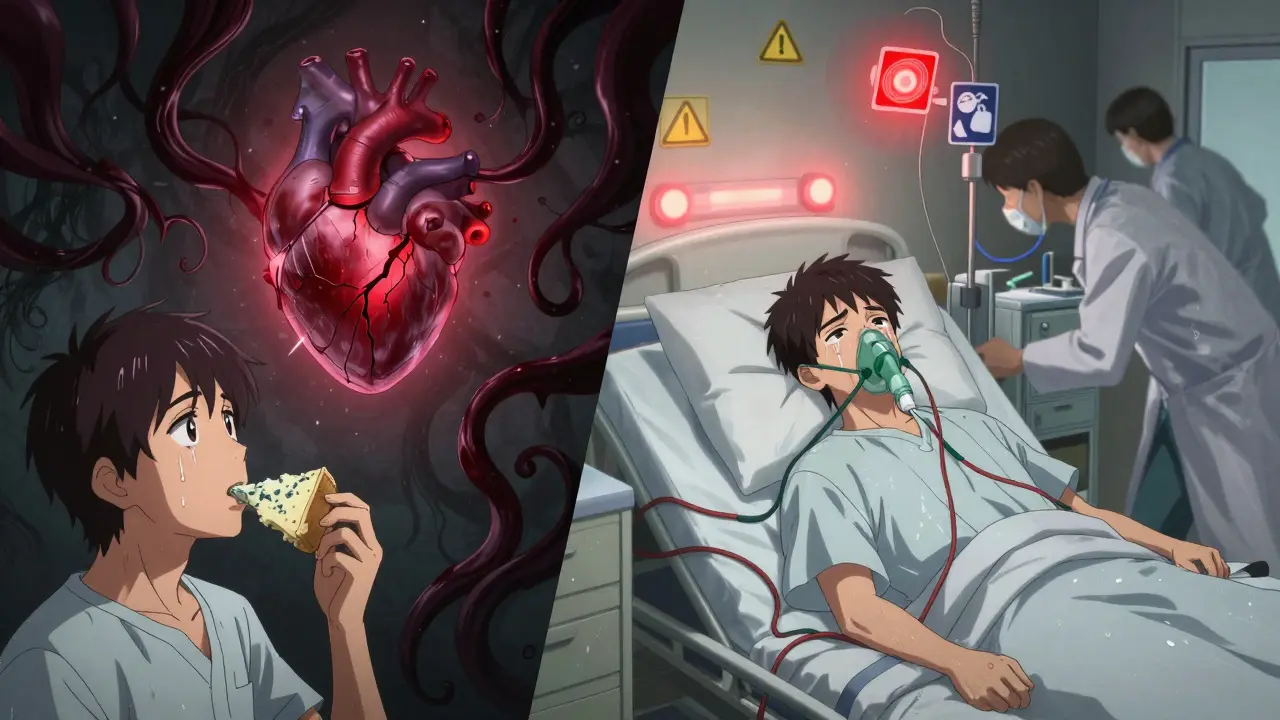
What About Case Reports That Say It’s Okay?
You might come across articles or forum posts claiming doctors have safely combined these drugs. There are a few case reports from specialized clinics where patients with treatment-resistant depression and ADHD were carefully monitored. One 2017 study from Massachusetts General Hospital followed 12 patients on lisdexamfetamine (Vyvanse) at low doses, with weekly blood pressure checks. No crises occurred. But here’s the catch: these were highly controlled situations. Patients were screened for existing high blood pressure, avoided tyramine-rich foods, started on tiny doses (10 mg Vyvanse), and had daily monitoring. These aren’t real-world scenarios. They’re exceptions under expert supervision. Dr. Richard Friedman from Weill Cornell Medicine says he’s seen over 200 cases without incident. But he also says, “The actual incidence appears exceedingly rare.” That’s not the same as “safe.” It means the risk is low-but not zero. And when the risk is death or stroke, even 1% is too high.Washout Periods Are Non-Negotiable
If you’re switching from an MAOI to a stimulant, you must wait at least 14 days. That’s how long it takes for your body to make new monoamine oxidase enzymes. Jumping in too soon-even after 7 days-can still cause a crisis. The same rule applies in reverse. If you’re stopping a stimulant to start an MAOI, wait 14 days. Don’t assume the stimulant is out of your system just because you feel fine. These drugs can linger, especially extended-release forms like Concerta or Vyvanse. Some patients try to “bridge” the gap with non-stimulant ADHD meds like atomoxetine or guanfacine. That’s a smarter approach. Atomoxetine doesn’t affect norepinephrine release the same way stimulants do. It’s not perfect, but it’s far safer.Who Should Never Try This Combination?
Even if you think you’re a good candidate, some people should never consider it:- Anyone with existing high blood pressure
- People with heart disease, arrhythmias, or history of stroke
- Those taking other serotonergic drugs (SSRIs, SNRIs, tramadol, dextromethorphan)
- Anyone who drinks alcohol regularly or uses recreational drugs
- Patients who can’t reliably avoid tyramine-rich foods

Why Are MAOIs Still Used at All?
MAOIs are rarely prescribed today. Less than 1% of antidepressant prescriptions in the U.S. are for MAOIs, down from 5% in 2000. They’re reserved for treatment-resistant depression-when every other option has failed. That’s because of their side effects: weight gain, sexual dysfunction, orthostatic hypotension, and now, this deadly interaction with stimulants. But for some patients, the benefits outweigh the risks. That’s why specialized clinics still use them. The American Psychiatric Association’s 2022 guidelines say combining MAOIs with stimulants is a “strong recommendation against” with “high quality of evidence.” That’s the strongest level of warning they give.What Should You Do?
If you’re on an MAOI and your ADHD symptoms are returning:- Don’t start a stimulant on your own.
- Don’t ask your doctor to “just try a low dose.”
- Don’t rely on online forums or anecdotal stories.
- Atomoxetine (Strattera)-a non-stimulant ADHD medication
- Guanfacine or clonidine-blood pressure medications that also help with focus
- Behavioral therapy, coaching, or organizational tools
- Switching from MAOI to a safer antidepressant like bupropion or sertraline
Sinéad Griffin
December 16, 2025 AT 18:56OMG I CAN’T BELIEVE PEOPLE STILL TRY THIS 😱 I had a cousin who did Adderall + MAOI and ended up in the ER with a headache so bad she screamed for 3 hours. She’s fine now but won’t touch stimulants again. Like… why even risk it? 🤦♀️🍎🧀
Rulich Pretorius
December 18, 2025 AT 14:35The danger here isn’t just pharmacological-it’s epistemological. We treat medical guidelines as absolute when they’re really consensus statements built on fear, case reports, and the weight of institutional inertia. The fact that a few clinicians have managed this combination under strict supervision suggests the risk is not zero-sum, but context-dependent. The real tragedy is that patients with complex comorbidities are denied options because the system can’t tolerate nuance.
Thomas Anderson
December 19, 2025 AT 15:07Look, I get the science, but if you’re on an MAOI and your ADHD is wrecking your life, what are you supposed to do? Atomoxetine doesn’t work for everyone. I’ve seen people try everything else and end up just… giving up. I’m not saying go for it, but don’t act like there’s no middle ground.
Dwayne hiers
December 19, 2025 AT 21:34Pharmacologically, the interaction is unequivocally synergistic in terms of noradrenergic overload. MAOIs inhibit the catabolism of both endogenous and exogenously administered catecholamines, while stimulants increase synaptic norepinephrine via reverse transport and vesicular depletion. The resultant hypertensive cascade is mediated by α1-adrenergic receptor overstimulation, leading to uncontrolled vasoconstriction, increased cardiac afterload, and potential catecholamine-induced cardiomyopathy. The 14-day washout isn’t arbitrary-it’s the approximate half-life of MAO enzyme regeneration. Any deviation is reckless.
Jonny Moran
December 20, 2025 AT 12:16For anyone reading this and feeling trapped-your mental health matters, but so does your life. You don’t have to choose between focus and survival. There are therapists who specialize in ADHD + depression combos, non-pharm tools like time-blocking and body doubling, and newer options like TMS that don’t play Russian roulette with your blood pressure. You’re not broken. You’re just in a system that doesn’t always see the whole person.
Alexis Wright
December 20, 2025 AT 18:17Oh please. The FDA says not to do it, so we all just bow down? You know how many people died because doctors said smoking was safe? Because ‘it’s never been proven dangerous’? This is the same playbook. Case reports exist. People are alive. But the system punishes innovation. If you’re smart enough to manage your own meds under supervision, why should some bureaucratic guideline decide your quality of life? The real danger isn’t the combo-it’s the dogma.
Tim Bartik
December 21, 2025 AT 23:40bro i tried vyvanse 2 weeks after stopping phenelzine bc i was ‘feelin’ fine’ and my head felt like it was gonna explode. like… literally my eyeballs were vibrating. i thought i was havin a stroke. now i just take strattera and i’m chill. but damn. don’t be that guy. i’m still scared to eat blue cheese.
jeremy carroll
December 23, 2025 AT 19:30you guys are overthinking it. if you’re careful, listen to your doc, and check your bp daily, you can make it work. i know someone who did it for 6 months and lived to tell the tale. life’s about balance, not fear. just don’t eat cheese and drink beer while on it 😊
Edward Stevens
December 23, 2025 AT 23:07Wow. So we’ve got a 2000-word essay on why you shouldn’t mix two drugs… and zero discussion about why we’re even prescribing MAOIs in 2025. Like… isn’t this just a relic of 1970s psychiatry? Maybe the real problem isn’t the combo-it’s that we still have MAOIs on the shelf at all.