

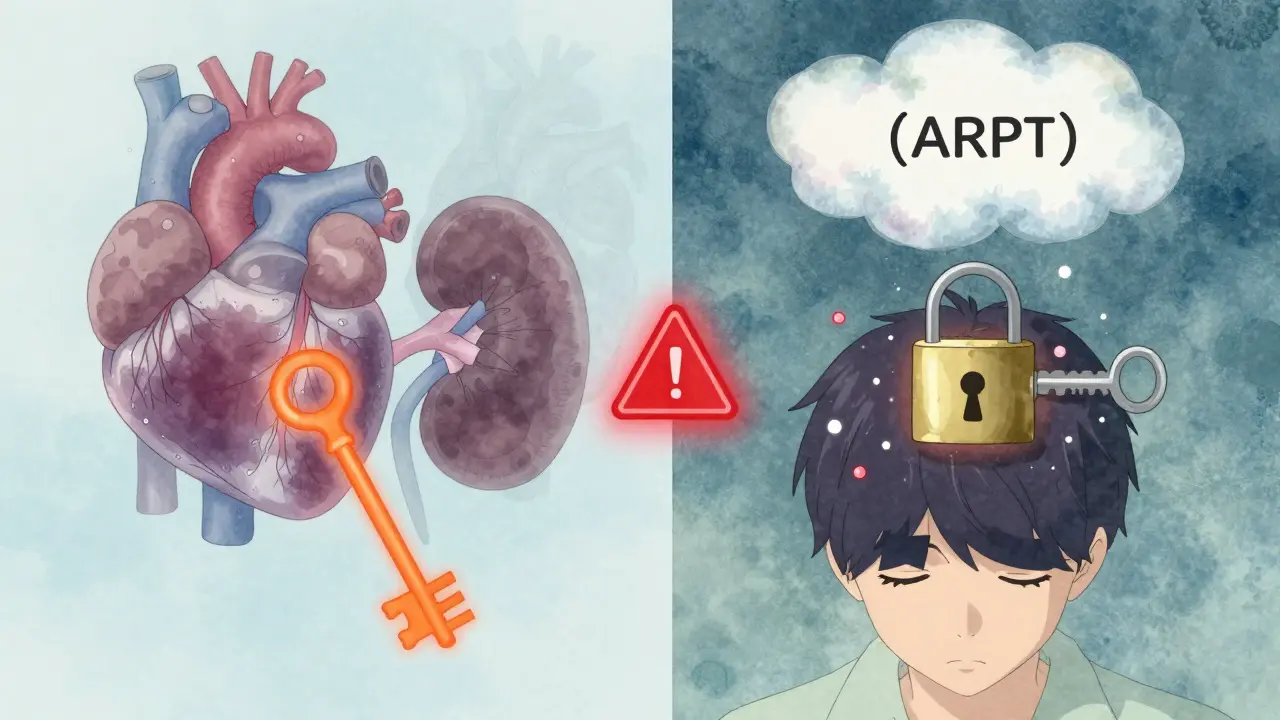
ACE Inhibitor/ARB Risk Calculator
Assess Your Risk of Serious Side Effects
Combining ACE inhibitors and ARBs doesn't improve blood pressure control but significantly increases your risk of dangerous side effects like high potassium levels and kidney injury. This tool helps you understand your personal risk based on your medical profile.
Your Risk Assessment
Key Risk Factors
What This Means
Next Steps
When managing high blood pressure, heart failure, or kidney disease, doctors often turn to two classes of medications: ACE inhibitors and ARBs. Both target the same system in your body-the renin-angiotensin system-but they do it in different ways. Many patients assume that because they work similarly, they can be used together for better results. That’s a dangerous assumption.
The truth is simple: combining ACE inhibitors and ARBs doesn’t give you better outcomes-it just raises your risk of serious side effects. Despite this, some patients still end up on both drugs at the same time, often because of confusion or outdated advice. By the end of this, you’ll know exactly why that’s a bad idea, what the real risks are, and what safer alternatives exist.
How ACE Inhibitors and ARBs Work (And Why They’re Not Interchangeable)
ACE inhibitors, like lisinopril and enalapril, block the enzyme that turns angiotensin I into angiotensin II. Angiotensin II is a powerful chemical that narrows blood vessels and tells your kidneys to hold onto salt and water-both of which raise blood pressure. By stopping its production, ACE inhibitors relax blood vessels and reduce fluid buildup.
ARBs, such as losartan and valsartan, take a different approach. Instead of blocking the enzyme, they block the receptor that angiotensin II binds to. Think of it like this: ACE inhibitors stop the key from being made; ARBs lock the lock so the key can’t turn it even if it’s there.
This small difference matters. ACE inhibitors cause a buildup of bradykinin, a substance that can lead to a persistent dry cough in 10-15% of users. ARBs don’t affect bradykinin, so cough rates drop to 3-5%. That’s why many people switch from an ACE inhibitor to an ARB-not because the first one didn’t work, but because the cough became unbearable.
There’s another subtle difference. ACE inhibitors lower angiotensin II levels overall. But after months of use, the body finds ways to make more angiotensin II anyway-this is called "partial escape." About two-thirds of long-term users see their angiotensin II levels creep back up, which can make blood pressure harder to control over time. ARBs don’t lower angiotensin II levels at all-they just block its action at one receptor type (AT1). This leaves the AT2 receptor free, which some researchers believe might have protective effects on the heart and kidneys.
The Big Problem: Combining Them Doesn’t Help-It Hurts
You might think, "If one drug lowers blood pressure, two should lower it more." But with ACE inhibitors and ARBs, that logic fails hard.
The ONTARGET trial, published in the New England Journal of Medicine in 2008, followed over 25,000 high-risk patients with heart disease or diabetes. One group got ramipril (an ACE inhibitor). Another got telmisartan (an ARB). A third got both. The combination group had no better protection against heart attacks, strokes, or death. But they had twice the risk of hyperkalemia (dangerously high potassium) and a 1.8-fold increase in acute kidney injury. Some even needed dialysis.
That wasn’t a fluke. The VA NEPHRON-D trial in 2018 confirmed it: in diabetic kidney disease patients, adding an ARB to an ACE inhibitor increased serious side effects by 27% without improving kidney function or survival. The FDA and major medical societies now say this combination should be avoided outside of rare, tightly monitored research settings.
Why does this happen? Both drugs reduce aldosterone, which causes your kidneys to hold onto potassium. When you double down, potassium can rise to dangerous levels-above 5.5 mmol/L. That can trigger irregular heartbeats or even cardiac arrest. At the same time, reduced blood flow to the kidneys can cause sudden drops in kidney function, especially in older adults or those with existing kidney disease.
Who’s at Highest Risk?
Not everyone who takes one of these drugs is at equal risk. Certain groups should be especially careful:
- People over 65
- Those with chronic kidney disease (eGFR under 45)
- Diabetics with protein in their urine
- Patients taking other potassium-raising drugs (like spironolactone or NSAIDs)
- Those who are dehydrated or on diuretics
A 2023 survey of 317 primary care doctors found that 89% had stopped prescribing the combination after the 2018 VA NEPHRON-D results. One nephrologist in Massachusetts reported discontinuing the combo in 87% of her 215 diabetic kidney patients because of rising potassium or worsening kidney function.
Even in patients who seem stable, switching from one to the other without a washout period can be risky. The 2023 ACC guidelines recommend waiting at least 4 weeks between stopping an ACE inhibitor and starting an ARB-or vice versa-to avoid overlapping effects. But studies show only 42% of doctors follow this advice.

What to Do Instead: Safer Alternatives
If your blood pressure isn’t controlled on one drug, adding another ARB or ACE inhibitor isn’t the answer. Here’s what works better:
- Switch classes: If you have a cough from an ACE inhibitor, switch to an ARB. If your blood pressure isn’t low enough on an ARB, add a calcium channel blocker like amlodipine.
- Add a low-dose diuretic: Hydrochlorothiazide or chlorthalidone can help lower blood pressure and reduce potassium buildup. This combo is far safer than doubling up on RAS blockers.
- Use a mineralocorticoid receptor antagonist: For patients with heart failure or proteinuria, low-dose spironolactone (12.5 mg daily) reduces protein in urine by 30-40% with a better safety profile than ARB+ACE combos.
- Consider ARNIs: For heart failure with reduced ejection fraction, drugs like sacubitril/valsartan (Entresto) have proven better than ACE inhibitors alone. They’re not for everyone, but they’re a legitimate next step.
For example, a 72-year-old with hypertension and mild kidney disease might start on lisinopril. If their pressure doesn’t drop enough, add amlodipine. If they develop a cough, switch to losartan. If their potassium rises, reduce the dose, add a diuretic, or switch to a non-RAS drug entirely.
Monitoring: What You Need to Track
Even if you’re on just one of these drugs, you need regular checks. Here’s what to monitor:
- Serum potassium: Check 1-2 weeks after starting or changing dose, then every 3 months.
- Creatinine and eGFR: A 30% rise in creatinine within weeks can signal kidney stress. Don’t panic, but don’t ignore it.
- Blood pressure: Keep home readings if possible. Many patients don’t realize their pressure is still high because they only check at the doctor’s office.
One real-world lesson: a patient on losartan who also takes ibuprofen for arthritis can see their potassium jump from 4.8 to 6.1 mmol/L in just 2 weeks. That’s not rare-it’s predictable. Always tell your doctor about every pill, supplement, or OTC drug you take.

Market Trends and What’s Coming
In 2023, ACE inhibitors made up 58% of RAS blocker prescriptions in the U.S., led by lisinopril. ARBs like losartan were close behind at 42%. But the trend is shifting toward single-agent use with add-on therapies-not dual RAS blockade.
Even the drug manufacturers have pulled back. The FDA has not approved any new combination of ACE inhibitor and ARB for hypertension. A new fixed-dose combo of perindopril and indapamide exists in Europe for heart failure, but it’s not approved in the U.S. and still carries warnings.
The future lies in newer agents like ARNIs and SGLT2 inhibitors (like dapagliflozin), which protect the heart and kidneys without the same risks. The FINE-REWIND trial, running from 2024 to 2028, is testing whether ultra-low-dose combinations might be safe-but even if they are, they’ll be for a tiny fraction of patients.
By 2028, experts predict less than 1% of RAS blocker prescriptions will involve ACE inhibitor-ARB combos. The focus is now on smarter, safer, single-drug strategies.
Final Takeaway: Less Is More
More drugs don’t mean better outcomes. With ACE inhibitors and ARBs, combining them doesn’t improve survival, hospitalizations, or kidney function-it just adds risk. The data is clear. The guidelines are firm. And real-world experience confirms it: patients on both drugs are more likely to end up in the hospital with high potassium or failing kidneys.
If your doctor suggests adding an ARB to your ACE inhibitor-or vice versa-ask why. Is it based on new evidence? Or outdated thinking? Most of the time, the answer is the latter.
Stick to one RAS blocker. Add a diuretic, a calcium channel blocker, or a newer agent if needed. Monitor your numbers. And never assume that doubling up on similar drugs will help. In this case, it won’t. It could hurt.
Can I take an ACE inhibitor and ARB together if my blood pressure is still high?
No. Even if your blood pressure remains elevated, combining an ACE inhibitor and ARB does not provide additional protection against heart attacks, strokes, or kidney failure. Instead, it doubles your risk of dangerously high potassium and sudden kidney injury. Safer options include adding a calcium channel blocker, a diuretic, or switching to a different class of medication entirely.
Why do some doctors still prescribe both drugs?
Some doctors may prescribe both based on older guidelines or anecdotal experience, especially in patients with heavy proteinuria. However, major studies like ONTARGET and VA NEPHRON-D show no benefit and clear harm. Most guidelines now explicitly warn against it. If your doctor suggests this, ask for the evidence behind it-and consider getting a second opinion.
What should I do if I’m already on both drugs?
Don’t stop either drug suddenly. Contact your doctor right away. They’ll likely recommend stopping one-usually the ARB-and monitoring your potassium and kidney function closely over the next few weeks. In most cases, you’ll be switched to a safer alternative like a diuretic or calcium channel blocker.
Are ARBs safer than ACE inhibitors?
For many people, yes. ARBs cause less cough (3-5% vs. 10-15%) and slightly less angioedema. They’re often used as a replacement when ACE inhibitors cause side effects. But they’re not safer when combined with ACE inhibitors. Both carry similar risks for high potassium and kidney issues when used alone-and those risks multiply when taken together.
How often should I get my blood work checked if I’m on an ACE inhibitor or ARB?
Check potassium and creatinine 1-2 weeks after starting or changing the dose. Once stable, every 3 months is standard. If you’re over 65, have kidney disease, or take other medications that affect potassium (like NSAIDs or potassium supplements), you may need checks every 1-2 months. Never skip these tests-they’re your early warning system.
APRIL HARRINGTON
March 9, 2026 AT 12:59So let me get this straight we’re told not to combine ACEi and ARBs because of hyperkalemia and kidney risks but then we’re told to add spironolactone which does the exact same thing?? That’s not a safer alternative that’s just a different flavor of the same poison
Peter Kovac
March 11, 2026 AT 11:33The data from ONTARGET and VA NEPHRON-D is unequivocal. Dual RAS blockade increases adverse events without improving hard outcomes. The 2023 ACC guidelines are not suggestions-they’re evidence-based mandates. Any deviation from monotherapy with RAS blockers requires documented clinical justification and serial monitoring. The notion that "it worked for my patient" is anecdotal and statistically irrelevant. This isn’t opinion-it’s epidemiology.
Leon Hallal
March 12, 2026 AT 19:32I’ve been on lisinopril for years. My BP is fine. My kidneys are fine. My potassium is fine. Then my doctor tried to switch me to losartan because I had a cough. I said no. I don’t need to be a lab rat. I’m not sick. I just have high BP. Why do they keep changing things when nothing’s broken?
Judith Manzano
March 13, 2026 AT 18:37It’s so refreshing to see someone break down the science like this. I’ve been on losartan for my kidney disease and honestly I was scared to ask if I could add something else. This made me feel way more confident talking to my doctor. Thanks for explaining the alternatives clearly. I’m going to ask about amlodipine next time!
Morgan Dodgen
March 13, 2026 AT 20:07Let’s be real-the FDA and Big Pharma don’t want you on one drug. They want you on three. That’s how they make money. The ONTARGET trial? Funded by Roche. VA NEPHRON-D? NIH money. Who benefits when you’re told to avoid combos? The companies selling calcium channel blockers and diuretics. The real risk isn’t hyperkalemia-it’s institutional groupthink. They scared us into single-agent therapy so they can upsell newer, pricier drugs like Entresto. Don’t fall for it. My uncle’s on both. He’s 81. Still hiking. No dialysis. Maybe the data doesn’t apply to real people.
Philip Mattawashish
March 14, 2026 AT 07:08You people are so naive. You think guidelines are based on science? They’re based on who paid for the study. The VA NEPHRON-D trial? It was buried for years because the results embarrassed the nephrology establishment. And now you’re parroting it like gospel. Meanwhile, patients with proteinuria? They need both. The data is cherry-picked. If you’re not a cardiologist with 30 years in private practice, you don’t know what actually works. I’ve seen 200 patients on both. Only 3 had issues. The rest? Stable. Healthy. The system wants you docile. Don’t be a sheep.
Tom Sanders
March 16, 2026 AT 03:51bro i just take my pill and go about my day why does this have to be so complicated
Jazminn Jones
March 16, 2026 AT 10:17While the clinical evidence against dual RAS blockade is compelling, one must acknowledge the nuanced clinical scenarios in which this paradigm may not be universally applicable. For instance, in patients with nephrotic-range proteinuria and refractory hypertension, the risk-benefit calculus may warrant individualized consideration under stringent supervision. Nevertheless, the prevailing guidelines remain robust, and deviations must be meticulously documented, with laboratory surveillance occurring at intervals no greater than biweekly during initiation or dose escalation.
Erica Santos
March 17, 2026 AT 07:27So we’re told not to combine ACEi and ARBs because it’s dangerous… but we’re told to add spironolactone, which also causes hyperkalemia? And we’re told to use diuretics, which cause dehydration, which also causes hyperkalemia? And then we’re told to monitor potassium… but if it goes up, we stop the drug… so we’re just playing whack-a-mole with physiology? This isn’t medicine. This is a game of risk roulette with lab numbers as the wheel.
Stephen Rudd
March 17, 2026 AT 16:00U.S. guidelines are out of touch. In Australia we’ve been using low-dose dual RAS blockade for high-risk CKD patients for over a decade. We don’t have the same rate of dialysis. We have better outcomes. Why? Because we don’t treat patients like data points. We treat them like humans. Your fear of potassium is making people sicker. Stop following American dogma.